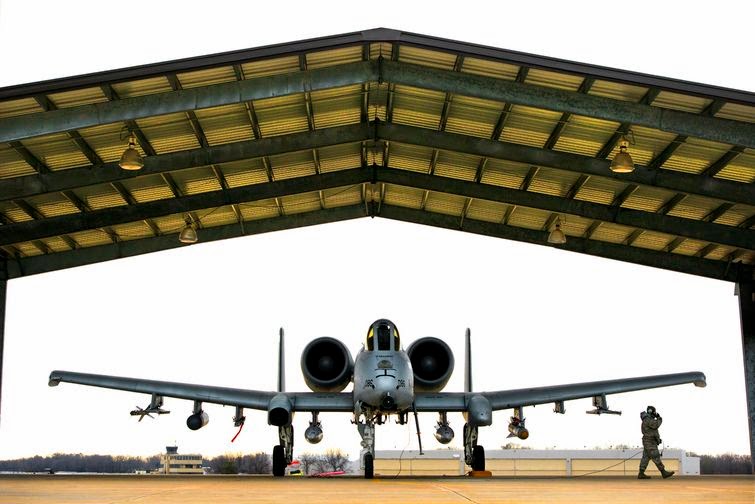
Congress took the first budgetary
step today toward preserving the A-10 aircraft fleet, including the planes at
Selfridge Air National Guard Base in Michigan, despite repeated attempts by the
Air Force to eliminate the jets affectionately known by the troops as the “Warthogs.”
According to The Hill, House Armed Services Committee Chairman Mac Thornberry (R-Texas)
released his version of the defense policy bill,
which blocks the retirement of the 300-plane A-10 fleet next year and bans the
Air Force from moving more than 18 jets to “backup inventory” status.
Congressional critics say the backup status is little more than a gradual Air
Force plan to send the A-10s to the military boneyard.
A fact sheet accompanying the
House Armed Services Committee’s initial budget actions cited “rigorous
oversight, endorsements from soldiers and Marines about the protection only the
A-10 can provide, and repeated deployments in support” of the war against
the Islamic State in Iraq and Syria (ISIS) for the decision to save the fleet.
It called the Air Force’s efforts to retire the A-10
“misguided.”
Thunderbolt II aircraft from Selfridge’s 127th Wing of the Michigan Air
National Guard were deployed to the Middle East to engage in the air war
against ISIS.
The future of the A-10 aircraft
could be directly linked to the survival of Selfridge, the last remaining major
military installation in Michigan. Without the A-10s, the only aircraft at the
sprawling, 3,600-acre base would be eight KC-135 mid-air tanker refueling
planes.
Selfridge, located in Harrison
Township on Lake St. Clair, is home to about 20 A-10s. The military installation
employs more than 4,000 full-time civilian and military personnel. The base is
credited with pumping hundreds of millions of dollars into the local economy
annually.
aircraft, these attack jets have increasingly become recognized as a key weapon against the ISIS militants in Syria and Iraq.
The House Armed Services Committee
fact sheet says Chairman Thornberry would welcome efforts at Wednesday’s bill “markup” to explicitly prohibit
the retirement of the A-10, leaving room for Rep. Martha McSally (R-Ariz.), a
former A-10 pilot and squadron commander, to propose an amendment.
“The administration’s
arguments have simply failed to hold up, and at hearing after hearing,
officials have conceded to me that going ahead with the plan to mothball the
A-10 … without replacements would create
dangerous gaps in our capabilities,” said McSally, according to The Hill.
mark up the defense bill Wednesday morning,
with deliberation of the bill expected to stretch into Thursday morning.
The committee’s bill clearly
rejects the Pentagon’s proposal to retire the A-10 attack jets. Instead, the
bill provides $682.7 million for the aircraft and modified a provision in last
year’s bill to allow not more than 18 A-10s to be placed into “backup flying
status” — down from 36 A-10s allowed in 2015.
The proposed
legislation also rejected the Pentagon’s proposal to authorize a new round of
base closures under the Base Realignment and Closure
Commission (BRAC) process. In addition, it provides a 2.3 percent pay
raise for troops, over the Pentagon’s proposed 1 percent pay raise.
The bill, known as
the National Defense Authorization Act (NDAA), authorizes $515 billion in
spending for national defense in fiscal year 2016 and an additional $89.2
billion for war funding, for a total of $604.2 billion.