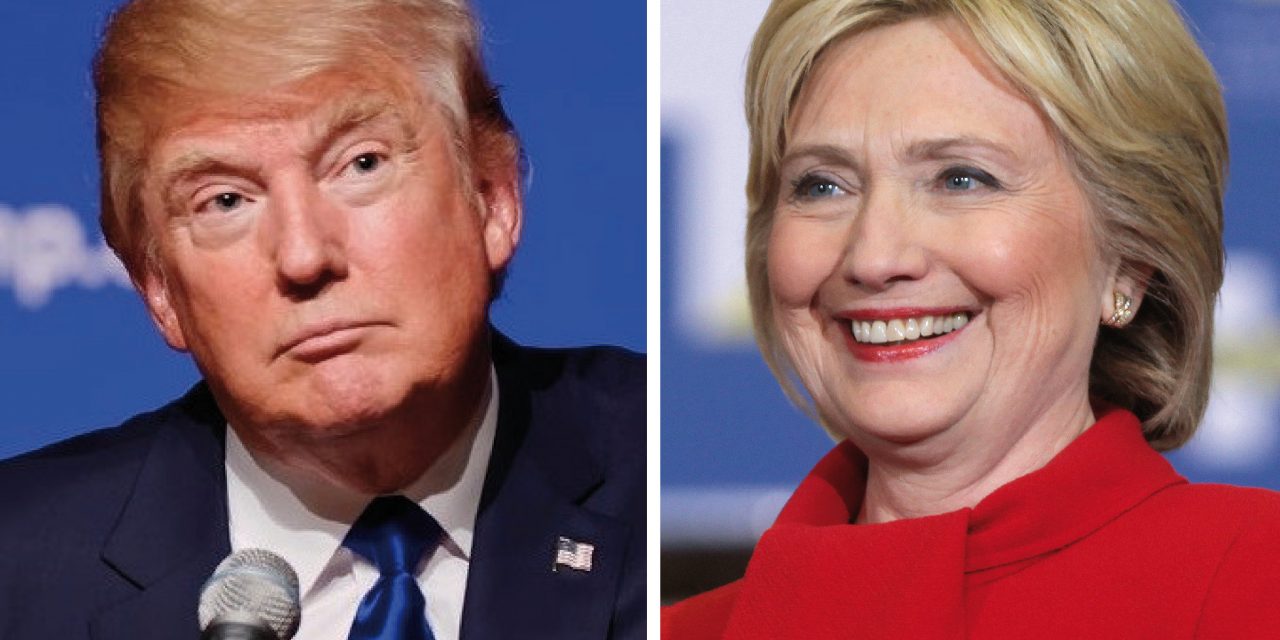
While both presidential campaigns have beefed up their on-the-ground staff of organizers and volunteers across the state, some indicators point to Michigan’s role fading fast in the battle between Donald Trump and Hillary Clinton.
The most tell-tale sign of strategic targeting in any presidential campaign is TV ad spending and Trump, who is very late to this game, tacitly gave a big hint over the weekend about his newest election strategy.
The Republican nominee’s new 30-second spot, which is backed by a modest $10 million ad buy, is slated to run this week in the battleground states of Colorado, Florida, Iowa, Nevada, New Hampshire, North Carolina, Ohio, Pennsylvania and Virginia.
Nothing in Michigan.
That list of nine targeted states represents the broadest possible definition at this point of a swing state. And Michigan is not on the list. What’s more, the targets include some longshots for the Trump camp.
Pennsylvania, once considered winnable for Trump despite its Blue State history, is now a point of extreme confidence among Democrats for a Clinton victory. Colorado and Virginia, also previously labeled as potentially Trump-friendly territory, now see the Clinton camp pulling back on its resources as the polls look very favorable for the Democratic nominee. Priorities USA, a pro-Clinton super PAC, is reportedly scaling back its ad investments in Colorado, Pennsylvania, and Virginia.
As for the ground game, Trump gained considerable attention when he announced that he will campaign at a black church in Detroit over Labor Day weekend. But that is part of a Hail Mary approach by the billionaire businessman to engage in outreach to the black community. Four years ago, President Obama got 93 percent of the vote in the Motor City.
Clinton’s sustained, substantial lead in Michigan – 8.6 percentage points in the Real Clear Politics polling average – may lead to one or both campaigns shifting their focus and cutting back on their Michigan operations soon. In addition, the lack of a Senate race in the Great Lakes State will certainly dissuade the Republican National Committee from spending large sums on ads here.
Overall, Michigan’s status as a swing state has been slipping for years. With six consecutive Democratic presidential victories here since 1988, another win in 2016 may push Michigan solidly into the Blue State column.
In 2012, native son Mitt Romney didn’t campaign here after the Republican National Convention. In 2008, John McCain shocked many GOP loyalists, including his running mate, Sarah Palin, by pulling his resources out of the state in September.
In 2016, Trump is playing catch-up against the former secretary of state in fundraising and the campaign has to establish firm priorities on where to spend its money. The Clinton campaign has spent $68 million on ads in the general election, while the Trump campaign has spent just $14 million, according to NBC News.
As of last week, NBC reported that, when outside groups are added into the mix, it’s Team Clinton at $114 million, and Team Trump at nearly $19 million. That’s a 6-to-1 advantage for Democrats.
So, as the final phase of the general election campaign kicks off this weekend, the numbers certainly point to a scenario in which Michigan might drop off the radar screen in a matter of weeks.
A sign of desperation on the part of the Michigan Republican Party emerged Sunday night when the MIGOP touted “the latest poll,” which showed Trump leading Clinton 44-43% in Michigan.
In fact, this was not a poll at all. This was Reuters’ attempt to project a winner in November, a new feature offered by several media outlets based on the success of fivethirtyeight.com. The “States of the Nation” project by Reuters combines opinion polls with an analysis of voting patterns under different election scenarios.
Other news organization that have created their own formulas to predict the state-by-state outcome put Clinton’s chances of winning in a range from 84% to 95%. Reuters’ prediction that Michigan is “too close to call” clearly serves as an outlier.
But perhaps the most surprising aspect of this forlorn GOP tactic was that it led voters to a page on the Reuters website that Republicans surely don’t want anyone to see. It shows Reuters’ current national projections – Clinton nearly has the Electoral College locked up and her chances of winning in November are now 95%.
Photos: CNN screenshots
Recent Posts:
 Kid Rock, Clinton and the clowns who protest
- Michigan companies can’t fill jobs because too…
- Warren ranked the most ‘white trash’ city in Michigan
- Michigan avoids being Foxconned – Snyder bailed out…
- The recession recovery: Michigan No. 1 while 35…
- Islamophobic SH candidate calls on Michigan Tea…
- Michigan counties face a heavy hurt under…
- Michigan Obamacare rate increases could average 28 percent