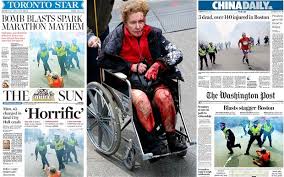
In the wake of all the false or misleading news reports
on Monday about the Boston Marathon bombings – inaccuracies that were quickly
spread far and wide by Facebook and Twitter – Slate has taken a close look at
how journalists (and political junkies) should handle themselves during a
crisis.
on Monday about the Boston Marathon bombings – inaccuracies that were quickly
spread far and wide by Facebook and Twitter – Slate has taken a close look at
how journalists (and political junkies) should handle themselves during a
crisis.
Slate’s Dave Weigel was the first to weigh in shortly
after the bombings occurred:
after the bombings occurred:
“My heart goes out to the people killed or maimed in
Boston today, and to their loved ones. In a situation like this, political
reporters should probably make a quiet, temporary exit from the scene. There
will be political angles in the reaction to this story, because this sort of
nightmare knocks everything else out of the news cycle. Gosnell?
Manchin-Toomey? Immigration? They’re in the middle of the paper if they’re
anywhere. They’re paused, as is any speculation about the motivation for the
attack. Who has ever speculated about that and not gone on to total, moronic
infamy?”
Boston today, and to their loved ones. In a situation like this, political
reporters should probably make a quiet, temporary exit from the scene. There
will be political angles in the reaction to this story, because this sort of
nightmare knocks everything else out of the news cycle. Gosnell?
Manchin-Toomey? Immigration? They’re in the middle of the paper if they’re
anywhere. They’re paused, as is any speculation about the motivation for the
attack. Who has ever speculated about that and not gone on to total, moronic
infamy?”
Slate’s social media editor, Jeremy Stahl, followed up
with a thoughtful piece on mistakes too many journalists make during a crisis.
The mistakes yesterday were many: the “bomb” at the JFK Library; the two/three/four
other “bombs” found; the shutdown of cell towers in Boston by authorities in
order to prevent remote bomb detonations; the suspect who was “in custody” at a
Boston hospital.
with a thoughtful piece on mistakes too many journalists make during a crisis.
The mistakes yesterday were many: the “bomb” at the JFK Library; the two/three/four
other “bombs” found; the shutdown of cell towers in Boston by authorities in
order to prevent remote bomb detonations; the suspect who was “in custody” at a
Boston hospital.
That last inaccuracy was propped up by Rep. Mike McCaul,
the Texas Republican who chairs the House Homeland Security Committee. McCaul
and a few other members of Congress contributed to the confusion by telling
cable TV outlets more than they actually knew as fact.
the Texas Republican who chairs the House Homeland Security Committee. McCaul
and a few other members of Congress contributed to the confusion by telling
cable TV outlets more than they actually knew as fact.
At one point, McCaul told Fox News that reports of ball
bearings embedded within the bombs indicated that the explosives were similar
to those used in IEDs by Middle Eastern terrorists.
bearings embedded within the bombs indicated that the explosives were similar
to those used in IEDs by Middle Eastern terrorists.
Even a casual observer of the news (let alone the top
lawmaker on homeland security measures) could instantly tell the difference
between the explosions caught on video in Boston and the countless videos we’ve
seen of massive IED explosions in Iraq and Afghanistan.
lawmaker on homeland security measures) could instantly tell the difference
between the explosions caught on video in Boston and the countless videos we’ve
seen of massive IED explosions in Iraq and Afghanistan.
Stahl suggests that those on Twitter not use an incident
like what happened in Boston to make jokes
about how Republicans are going to blame Obama for this, or Democrats will
point fingers at congressional GOP leadership.
like what happened in Boston to make jokes
about how Republicans are going to blame Obama for this, or Democrats will
point fingers at congressional GOP leadership.
“… Don’t use a tragedy to make a political point before
the facts are even known. Shortly after the attacks, New
York Times columnist Nicholas Kristof tweeted this inanity: “explosion is a reminder that ATF needs a
director. Shame on Senate Republicans for blocking apptment.” Probably
realizing how his snarkiness sounded under the circumstances, Kristof quickly
deleted the tweet and called it a ‘low blow.’ On the right, Washington
Post columnist Jennifer Rubin sent out a doozy, comparing the national media’s coverage of Boston to
its alleged
non-coverage of the Kermit Gosnell abortion-murder case.”
the facts are even known. Shortly after the attacks, New
York Times columnist Nicholas Kristof tweeted this inanity: “explosion is a reminder that ATF needs a
director. Shame on Senate Republicans for blocking apptment.” Probably
realizing how his snarkiness sounded under the circumstances, Kristof quickly
deleted the tweet and called it a ‘low blow.’ On the right, Washington
Post columnist Jennifer Rubin sent out a doozy, comparing the national media’s coverage of Boston to
its alleged
non-coverage of the Kermit Gosnell abortion-murder case.”
On Facebook, some of the vile, tasteless attempts at
scoring political points in the midst of an unfolding national tragedy were unforgiveable. I know I will be spending part of
my day “unfriending” some FB freaks.
scoring political points in the midst of an unfolding national tragedy were unforgiveable. I know I will be spending part of
my day “unfriending” some FB freaks.