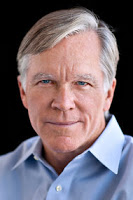
On his blog, Bill Keller, former executive editor of The New York Times, deals with the question of what is a moderate, a centrist.
 |
|
| Bill KellerNYT photo by Tony Cenicola |
We all know that the independents in the middle of the ideological spectrum decide elections. Keller sees two candidates in Barack Obama and Mitt Romney who can successfully, legitimately vie for moderate voters. The two party standard-bearers are unlike Rick Santorum, who recently said: “We don’t win by moving to the middle. We win by getting people in the middle to move to us.”
Shortly after uttering that declaration, Santorum’s campaign was finished.
Keller points out that candidates don’t fire up the electorate by appealing to the middle:
“Centrism is easily mocked and not much fun to defend. Many on the left who find Santorum’s politics repellent would agree with him that moving to the middle is intellectually uninspiring and morally unsatisfying. Even if you are not someone who thrills to the trumpets of moral clarity or regards ‘uncompromising’ as the highest praise, you can see where they’re coming from. The politics of the center — including the professional centrists and trans-partisans of groups like Third Way and Americans Elect — do not quicken the pulse. White bread, elevator music, No Labels, meh.”
But Keller goes on to point out that centrists are often stereotyped and misunderstood:
“The middle is not the home of bland, split-the-difference politics, or a cult that worships bipartisan process for its own sake. Swing voters have views; they are just not views that all come from any one party’s menu.
“… Swing voters, I think, are looking not for a checklist of promises but for a type of leader — a problem-solver, a competent steward, someone who understands them and has a convincing optimism. We don’t know exactly how they identify that candidate, but it is some mix of past performance (especially for the incumbent), campaign messaging and chemistry.”
He also offers the results of research done at the Third Way that explains the mix of liberal and conservative views that are typical among centrists.
You can read the entire column here.