

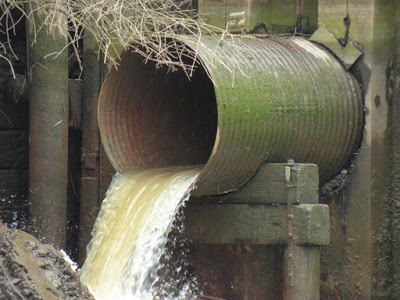

A bipartisan group of politicians recently gathered on the
banks of the Clinton River to praise a $20 million federal grant awarded to “restore”
the river to its former status as a recreational resource.
That $20 million – it sounds like a lot. But it will take a
lot more than that to reverse decades of pollution flowing into the Clinton. And
the politicians know better.
waste and sewage even as it flows through some of the most densely populated
areas of Michigan, in Macomb and Oakland counties.
The fouling of the waterway has been carried out for so long
that that spending $20 million from the Environmental Protection Agency to
stabilize riverbanks, improve wildlife habitat and remove invasive species of
weeds clearly misses the mark.
One piece of the grant calls for improvements to a creek in
Oakland County far upstream in the hopes of turning the lower Clinton River
into a prime fishing area for trout. Another allocation would improve flow in
the tiny McBride Drain in Macomb Township, which enters the north branch of the
Clinton at the popular Hickory Hollow and Sycamore Hills golf courses.
something,” said Doug Martz, who served as the first and only chairman of the
Macomb County Water Quality Board before it was disbanded in 2011. “You’ve got
to fix the sewers. That’s the only way you can fix the Clinton River.”
spewing into the river then engage in improved wildlife habitat and recreational
uses in a post-pollution era. In the lower stretches of the river, kayaking,
canoeing and fishing will never gain public appeal until the Clinton’s brown
hue is cleared up.
But it won’t be cheap. Some estimate that separating the
sewers in southeast Oakland County and neighboring Warren – one pipe for
rainwater, one pipe for toilet water – could hit a price tag of $1 billion. That
cost includes finding and eliminating the many illicit connections where pollution
is secretly piped into the river through tributaries and storm drains.
Until then, the Clinton River will suffer from high E.coli
bacteria levels that flow into Lake St. Clair. And dozens of beach closings
will continue to occur along the lakeshore every summer.
Candice Miller (R-Harrison Township) and Sandy Levin (D-Royal Oak), and Macomb
County Executive Mark Hackel gathered earlier this week for a press conference
to praise the EPA grant money, they failed to explain that that this aid for
the river is a drop in the bucket.
The money comes from the Great Lakes Restoration Initiative,
a seven-state federal effort to gradually improve dozens of degraded waterways
feeding the lakes that are known, in bureaucrat-speak, as “Areas Of Concern,”
or AOCs. The Clinton was put on the list of AOCs decades ago.
Martz in denigrating the $20 million amount of the grant. The nonprofit
organization has produced videos that highlight the so-called muck mats on the
lake shoreline – layers of disgusting algae, debris and sewage.
“Give
us one million of those dollars and we will show you exactly how much we can
clean our shoreline and make an immediate impact … (by) removing the toxic muck
that includes human waste along several spots in the lake,” the group said on
its Facebook page. “How they continue to let this remain in our waters is mind
blowing.”
most polluted areas. For example, $4.5 million will upgrade and spruce up the
banks of the river through Sterling Heights and Utica. Apparently, planting wildflowers is in the
works.
Yet, the Clinton in Sterling Heights already exhibits the kind
of water quality that is dreamed of for the rest of the river to the east. The
clear waters by the Yates Cider Mill property and Dodge Park stand in stark
contrast to the brownish-green flow that begins by Utica and Hayes roads.
That’s where the Red Run Drain dumps the pollution from
Oakland County and Warren into the river. Downstream from there, the Clinton is
never the same.
infrastructure is much worse below ground compared to the substandard
transportation system on the surface.
“Imagine,” he said, “what those sewers look like underground
compared to the condition of our roads and bridges.”




We agree with this article. Hopefully, so do the politicians. 20 Million is not even close to the amount needed to SAVE LAKE ST. CLAIR. Don't get us wrong. We are happy the 20 Million is here. ABSOLUTELY! However, please, please, please politicians and our community of supporters, do not say that the pollution in the lake is being taken care of and will be fixed from this 20 Million. We need to understand that we need to fix our outdated, overloaded system from dumping sewage. We need to remove the toxic muck mats we show along our entire shoreline. Here's a good analogy to put in perspective…pretend that our house is on fire and someone brings a bucket full of water to help…are we happy they brought the bucket of water? Of course, but we need the entire fire department to show up and turn on the hoses at full blast. The 20 Million, in this case, is the bucket. We need major improvements if we wish to protect out lakes, our beaches, our fishery, and, most important, our drinking water.