UPDATE: The McClatchy newspapers have also taken a look at the Oxford Internet Institute’s study of Michigan social media leading up to the November election and they found that campaign-related tweets, including fake news, were more favorable to Donald Trump than Hillary Clinton by about a 3-1 margin.
In Michigan last fall, residents sent 138,686 politically related tweets during the seven days leading to the Nov. 8 election and for three ensuing days, according to Twitter data collected by the OII researchers. Of those 78,662, or 56.7 percent, were pro-Trump and 28,074, 20.2 percent, were pro-Clinton, McClatchy reported.
Professor Philip Howard of OII said that a third of the so-called “junk news” shared via Twitter in Michigan during the 10-day period came from five far-right news sites — Breitbart News, InfoWars, the Daily Caller, Liberty Alliance and Truthfeed.
A March 2016 survey by the nonpartisan Pew Research Center found that about 21 percent of Americans were using Twitter, with 36 percent engaged in tweeting among people ages 19 to 29.
“The problem is that voters in a state like Michigan were learning about conspiracies more than fact,” said Howard, who led the research.
*****
The folks at the Oxford Internet Institute in England took a long look across the pond and found a glaring example of fake news playing a leading role during election time here in Michigan.
Researchers at OII studying what they call “junk news” focused on Michigan as a battleground state that played a key role in the November presidential election. What they found is that half of the campaign-related posts online dealing with the election came from fake news sites.
Professor Philip Howard, who led the project, said the proportion of fake news and actual news was 50-50.“In the case of Michigan, we found that the proportions were about equal,” Howard said in an interview with CBS News. “The junk news with stories that had not been fact-checked and that came from organizations that were not professional journalism organizations, was about as much as the amount of content coming from the professional news organizations.”
Overall, the OII, based at Oxford University, determined that 23 percent of the posts tweeted by a sample of 140,000 Michigan-based users in the 10 days leading up to the Nov. 8 election came from sites that consist of “various forms of propaganda and ideologically extreme, hyper-partisan or conspiratorial political news and information”. Professional news sites, defined as political news and information by outlets that display the qualities of professional journalism, were the source for another 23 percent.
 Howard said the studies were an attempt to scientifically research the widespread campaign strategy of manipulating public opinion on Twitter and Facebook.
According to the Financial Times of London, the researchers also categorized links to Russian-origin news stories and unverified WikiLeaks content. Taken together with fake news, content in these three categories was shared more widely overall than professional news.
“I think it’s safe to say that’s a bad thing for public life and the political conversation in (Michigan),” Howard said.
Two OII reports released last week also show that social media users in Michigan engage in far more fluff subjects online than people in Germany. Though the recent German elections selected a president — a mere figurehead in Berlin politics chosen by the parliament — Germans on social media were far more engaged in serious discussions than Michiganders were in the lead up to President Donald Trump’s win.
Only 10 percent of Twitter users posting between Feb. 11-13 about the German presidential election relied on fake news. Professional news was shared at essentially double the rate it had been in the Michigan study — 45 percent.
CBS’ “60 Minutes” on Sunday night reported about the OII studies and interviewed others who have experienced the fake news phenomenon from the inside.
To be clear, this is not about what angle on a story is taken by an established news organization or whether a particular report is entirely accurate. This is about sites that report wild claims such as Trump was dropping out of the presidential race due to a brain tumor, or that an FBI agent investigating Hillary Clinton’s emails was mysteriously murdered.
Jeff Green, who helps companies steer clear of advertising on fraudulent sites, said that the urge to believe outrageous political stories is found among conservatives and liberals. The CEO of Trade Desk said that right-leaning fake news overwhelmingly attracted readers in their 40s and 50s. And fake-news readers on the left were more likely to be affluent and college-educated.
60 Minutes correspondent Scott Pelley also interviewed one of the shameless fraudsters who realized in 2016 that producing fake news is a quick and easy way to make a lot of money.
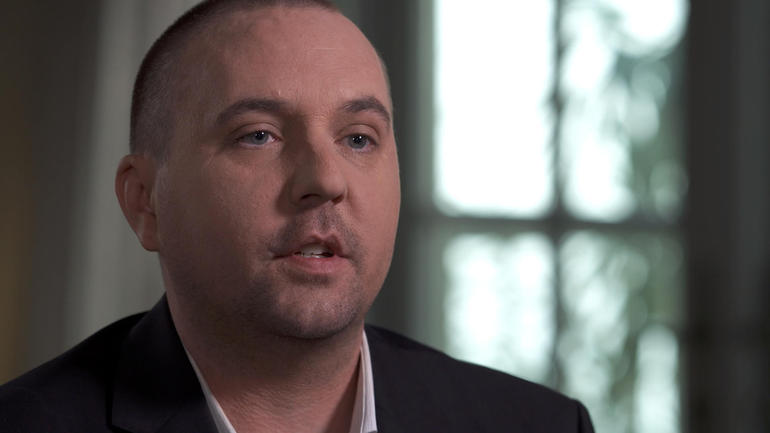
Jestin Coler, who runs two fake news sites, explained that the key to success is to tap into hyper-partisan readers’ confirmation bias, to lure them in with content that makes their “blood boil.”
Here’s part of the exchange that Pelley had with Coler:
Coler
Coler: It’s kind of almost an addiction, right? You kinda see something really take off, and then as it’s coming down you’re kinda lookin’ for that next high, I guess.
Narration: His highs were profitable. With each click, he made money on ads—over $10,000 a month he told us, writing fiction posing as fact.
Coler: Facebook really was key to what we did.
Pelley: How?
Coler: Well, we would basically join whatever group it is that you’re trying to target on Facebook and once they kind of took the bait so to speak they would spread this stuff around, they would be the ones that would essentially be our ‘bots*.’
Pelley: What did you discover about the audience?
Coler: You know, people in general are quick to believe anything that is — not anything, but — well, yeah, basically anything that’s put in front of ‘em in a format that is news-ish.
… You need to talk in their language about very specific words that kind of get that emotional response. That’s really the key to it all. The key to all of the fake news.
*“Bots” are a means of spreading social media content through computer automation in a quick, exponential manner.