The prevalence of so many consumer protection websites
and the explosion of e-commerce has made it possible for researchers to prove
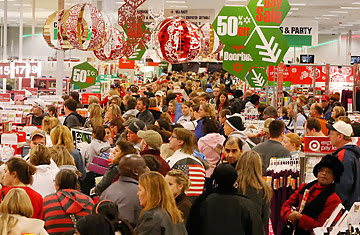
what many of us suspected — those “door-buster” discount prices on Black Friday
are a scam.
and the explosion of e-commerce has made it possible for researchers to prove
what many of us suspected — those “door-buster” discount prices on Black Friday
are a scam.
The Wall Street Journal calls this annual
post-Thanksgiving ritual “retail theater.”
post-Thanksgiving ritual “retail theater.”
By tracking prices before and after big sales, those who
keep tabs on these things have found that the so-called original price on a
wide array of items is phony.
keep tabs on these things have found that the so-called original price on a
wide array of items is phony.
WSJ pointed out that Amazon.com Inc. is featuring a Samsung 60-inch HDTV in its 2013 Holiday Gift
Guide. The TV is selling at a 45 percent discount compared to its “list price”
of $1,799.99. But, according to Decide.com, a price-tracking firm owned by eBay
Inc., the TV hasn’t sold for anywhere near the list price in months. The most
it has sold for in the past eight months is $1,297.85, according to Decide.com.
As recently as October, it was priced at $997.99, about the same as its current
sale price.
Guide. The TV is selling at a 45 percent discount compared to its “list price”
of $1,799.99. But, according to Decide.com, a price-tracking firm owned by eBay
Inc., the TV hasn’t sold for anywhere near the list price in months. The most
it has sold for in the past eight months is $1,297.85, according to Decide.com.
As recently as October, it was priced at $997.99, about the same as its current
sale price.
The floodgates have opened to price-cut hype, to the
point that when a retailer such as J.C. Penney established a policy of no sales
and no coupons, the result was disastrous for the company.
point that when a retailer such as J.C. Penney established a policy of no sales
and no coupons, the result was disastrous for the company.
Here’s a portion of the WSJ report:
In a 2012 presentation, the Penney’s CEO who initiated
the policy “said the company was selling fewer than one out of every 500 items
at full price. Customers were receiving an average discount of 60 percent, up
from 38 percent a decade earlier. The twist is they weren’t saving more. In
fact, the average price paid by customers stayed about the same over that
period. What changed was the initial price, which increased by 33 percent.
the policy “said the company was selling fewer than one out of every 500 items
at full price. Customers were receiving an average discount of 60 percent, up
from 38 percent a decade earlier. The twist is they weren’t saving more. In
fact, the average price paid by customers stayed about the same over that
period. What changed was the initial price, which increased by 33 percent.
“‘The silliness of it all is that the original price from
which the discount is computed is often specious to begin with, because items
hardly ever sell at that price, which makes the discount less legitimate,’”
said Mark Cohen, a professor at the Columbia Business School who worked at the
company and has held other retail posts including CEO of Sears Canada
Inc.
which the discount is computed is often specious to begin with, because items
hardly ever sell at that price, which makes the discount less legitimate,’”
said Mark Cohen, a professor at the Columbia Business School who worked at the
company and has held other retail posts including CEO of Sears Canada
Inc.
The price-illusion strategy may face a serious
challenge in the coming months as consumers have filed lawsuits against J.C.
Penney, Kohl’s Corp. and Jos A. Bank Clothiers Inc.
challenge in the coming months as consumers have filed lawsuits against J.C.
Penney, Kohl’s Corp. and Jos A. Bank Clothiers Inc.