Imagine for a moment if a presidential candidate in 2004,
near the height of the Iraq War, had said that the world would be better off if
Saddam Hussein had remained in power. Or that another Middle East dictator,
backed by Russia, had understandably kept his people in line through human rights violations.
Surely, that would have emerged as one of the biggest
stories of the entire ’04 campaign. And the candidate quickly would have been
drummed out of the race.
bullet-proof Donald Trump.
Press,” the Republican frontrunner said that the Middle East would absolutely
be a better place if Saddam Hussein and Moammar Ghadafi were still in power.
“It’s not even a contest,” he told MTP host Chuck Todd,
mimicking the view of some foreign policy critics who say that the two dictators
managed to keep the peace in Iraq and Libya by keeping their populations under
control.
Trump went further by suggesting that the Mideast would
also benefit if Syrian strongman Bashar al-Assad reconstituted his power over
the war-torn nation.
probably a bad guy,” Trump said.
Probably?
Like father, like son
was while ruling Syria with an iron fist as the supreme leader for three
decades. But the son has firmly established himself, with the help of two sham
elections, as a barbaric bad guy who’s certainly not worthy of a “probably”
qualifier.
His military actions against his own people in the
ongoing Syrian civil war has prompted calls for charging Assad with war crimes
that left 250,000 Syrians dead and displaced 4 million more.
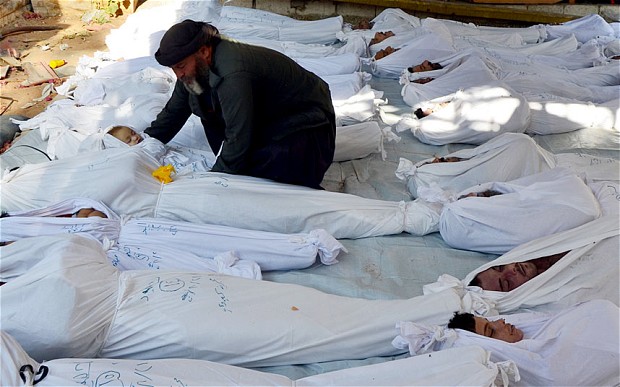
crossed the line by using chemical weapons to inflict what one U.S. official
described as an “indiscriminate, inconceivable horror” that killed nearly 1,500
civilians, including at least 426 children, on the outskirts of Damascus.
Assad’s forces also have utilized barrel bombs on a regular
basis in heavily populated areas. A barrel bomb is, just as the name implies, a
metal barrel that is filled with TNT, petroleum and scrap metal and tossed out
of a helicopter or low-flying plane.
Beyond a massive explosion, these weapons launch metal shrapnel in every direction and create huge fires. Unlike a guided missile,
these bombs are dropped in an indiscriminate manner, routinely hitting
residential buildings.
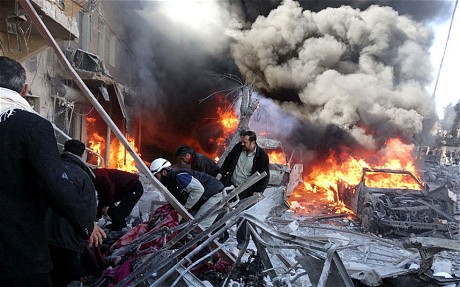 |
| Destruction caused by barrel bombs in 2014 in Aleppo, Syria. |
which is closely tied to Russia and Iran, had a horrific track record on human
rights prior to the war. In fact, it was the Assad regime’s brutality that ignited
the Arab Spring protests in Syrian cities that drew hundreds of thousands of
protesters. Unlike some other Mideast leaders at the time, the Syrian president’s
response was to cling to power by killing his own people.
In the decade after he succeeded his father in 2000, human rights
groups such as Human Rights Watch and Amnesty International detailed how Assad’s secret
police routinely tortured, imprisoned, and killed political opponents and
those who spoke out against the regime.
Is it any wonder that Russian President Vladimir Putin, a
former KGB agent, has emerged as Assad’s strongest ally in the civil war, first
supplying the regime with money and weapons and now inserting Russian planes
and troops to wipe out the opposition – ISIS or otherwise?
policy response to the chaos in the Middle East makes it easy for Trump and
other presidential candidates, including the president’s former secretary of
state, Hillary Clinton, to toss out innumerable criticisms of U.S. strategy and
tactics.
Massive flip-flop
But Trump has gone a step further by incrementally
engaging in a massive flip-flop on the most significant foreign policy issue –
how to contain and destroy ISIS.
A couple months ago, Trump, declaring himself essentially
the “most militaristic” man in America, said that he would send U.S. troops
into ISIS territory to surround and destroy the terrorist group. Given ISIS’
broadening horizons, such a mission would likely require hundreds of thousands
of American boots on the ground.
Trump began backpedaling on that goal last month and in
the MTP interview he completed his 180-degree reversal. Any nation who tries to
wipe out ISIS and the diverse group of rebels fighting Assad’s troops “is going
to get bogged down in Syria,” he said, so let’s sit back and let the Russians
make that mistake.
That jolting, whiplash-worthy change of views, in just two months,
makes Trump not only an uninformed candidate but a dangerous candidate.
Worse yet, do we really want to take a chance on a
potential president who can’t tell the good guys – such as they are — from the
bad guys?
Recent Posts:
 Michigan companies can’t fill jobs because too…
- RNC reportedly discusses eliminating ‘bad guy’ Yob…
- Obamacare in a ‘death spiral?’ GOP and Berniecrats…
- How low can the bar go in Detroit elections?
- Trump team favors Kid Rock over solid GOP field for Senate
- Could Trump-induced mess in Washington lead to a new…