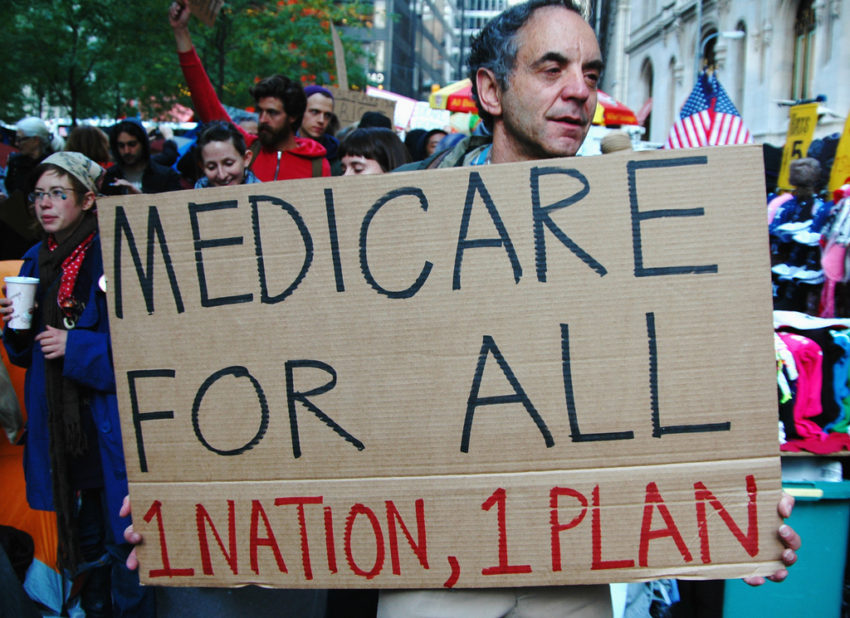
The “Medicare for all” proposal advocated by Sen. Bernie Sanders and embraced by numerous liberal Democratic candidates in the upcoming midterm elections could cost $32.6 trillion over the next decade, single-handedly boosting the nation’s federal debt by 55 percent.
That was the conclusion of a study released today by George Mason University’s Mercatus Center, a prominent libertarian-leaning policy center. The center’s research asserted that extending Medicare benefits to the entire population would require a massive tax hike. Mercatus claims that their findings align with a similar analysis performed by the liberal Urban Institute.
The federal government could double all corporate and individual income taxes and it would still fall far short in revenue to fund the universal health care program, according to the Mercatus study.
“Enacting something like ‘Medicare for all’ would be a transformative change in the size of the federal government,” said Charles Blahous, the study’s author.
Yet, the study sparked a typical war between the left and right, based on partisan views of the same research results.
Liberal commentators, doing a deep-dive into the Mercatus numbers, claim that the nation could insure 30 million more Americans and virtually eliminate out-of-pocket health care expenses while saving $300 billion in the process.
It sounds a bit ridiculous but Matt Bruenig of the left-wing People’s Policy Project offers an explanation:
When talking about Medicare for all, it is important to distinguish between two concepts: national health expenditures and federal health expenditures. National health expenditures refer to all health spending from any source whether made by private employers, state Medicaid programs, or the federal government. It is national health expenditures that, according to the report, will decline by $303 billion.
Federal health expenditures refer to health spending from the federal government in particular. Since the federal government takes on nearly all health spending under Medicare for all, federal health expenditures will necessarily go up a lot, $32.6 trillion over the 10-year period according to Blahous. But this is more of an accounting thing than anything else: rather than paying premiums, deductibles, and copays for health care, people will instead pay a tax that is, on average, a bit less than they currently pay into the healthcare system and, for those on lower incomes, a lot less.
Beyond all skepticism about that explanation and the tax implications, Medicare for all typically fails to address the inherent generational unfairness of such a system. Seniors who paid Medicare payroll taxes throughout their working lives would share a massive health care system with young adults who have paid little or nothing into the kitty.
More disturbing is that in the Medicare for all plan, left-wingers have extended their “free stuff” attitude by proposing a significantly expanded benefit system that would require no co-pays or deductibles. That stands in dramatic contrast to the Medicare system of recent decades that has required substantial out-of-pocket costs for seniors, in addition to supplemental “Medigap” plans offered by private insurers, at significant cost, to avoid catastrophic medical bills.
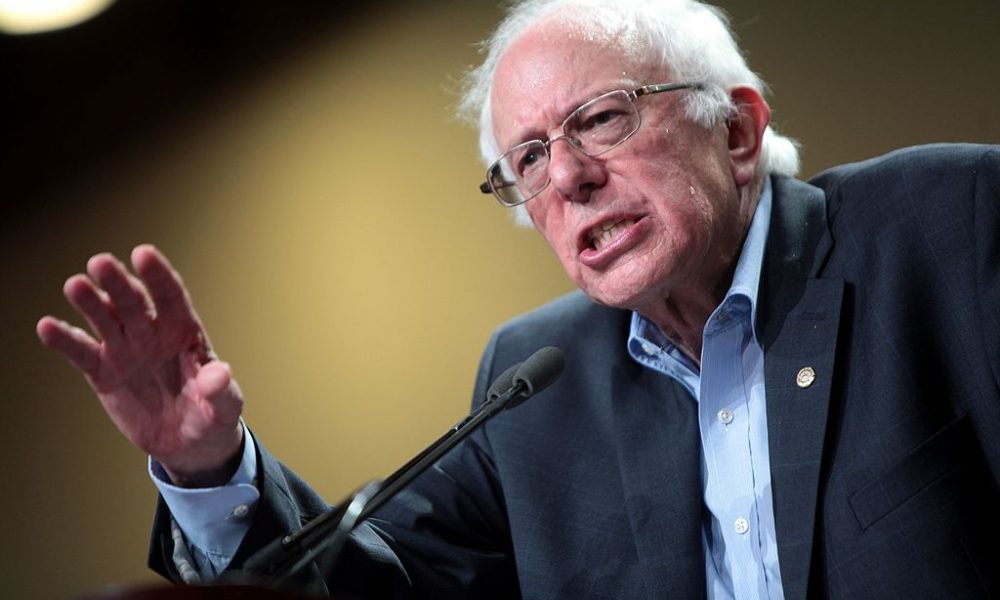
Sanders
Sanders quickly denounced the Mercatus Center study, claiming it was distorted by contributions the center receives from the infamous Koch Brothers.
Yet, even if the study is off by several trillion dollars, it will only add to the increasing anxiety felt by moderate Democrats who see leftists becoming the loudest voices within their party.
NBC News reported that traditional Democratic members of Congress fear that the left turn by activists and many congressional candidates spells big trouble. The increasing national role played by Alexandria Ocasio-Cortez, a vaunted democratic socialist who scored a stunning primary win last month over an entrenched Democratic congressional incumbent in New York City, has increased the intraparty intensity.
The sharp cultural and political differences between the Bronx, Ocasio-Cortez’s home territory, and Middle America serve as a dividing line in the debate over the future of the party.
If the move toward free health care and free college tuition gains traction, “We will be a permanent minority party in this country,” Jeff Danielson told NBC. An Iowa state senator, Danielson is a firefighter who represents an area that saw one of the biggest swings from Barack Obama to Trump during the 2016 election.
As a campaign platform, government-run health care, Danielson said, “does not work in the rest of America … and I’m tired of losing.”
Ocasio-Cortez campaigned in Michigan this past weekend to boost the electoral fortunes of Abdul El-Sayed, a democratic socialist running for governor who is trying to make up ground in next week’s state primary.
Meanwhile, the “Opportunity 2020” convention held in Columbus, Ohio, a week earlier by mainstream Democrats represented a highly publicized effort to counter the rising populist-left in the party, particularly among Millennials. Third Way, a moderate Democratic research group, gave middle-of-the-road party members a safe space to come together and voice their concerns.
“The only narrative that has been articulated in the Democratic Party over the past two years is the one from the left,” former Delaware Gov. Jack Markell told NBC News.
“I think we need a debate within the party,” he added. “Frankly, it would have been better to start the conversation earlier.”