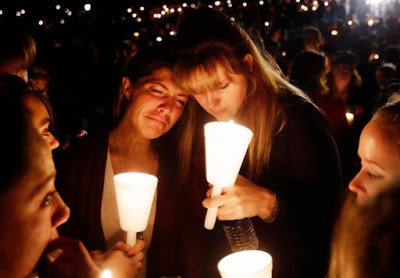
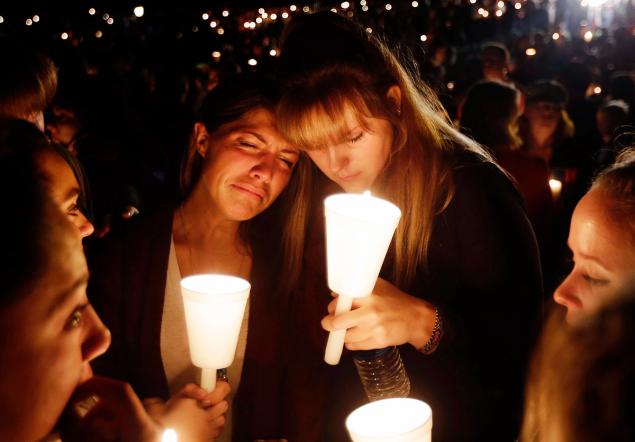
The mass shooting in Oregon last week sparked another round
of Facebook wars, with those who hold a strict interpretation of the Second
Amendment engaging in heated arguments with those who demand more gun control.
As a veteran of these online rhetorical battles, I have a
suggestion: Maybe it’s time for a truce.
lament: Mass murders keep shocking the
nation, at least temporarily, but nothing is ever done about it.
I would argue that, just maybe, this time was different.
The coverage in a wide variety of media outlets in recent days took a deep dive
and came up with some facts and figures that could help silence all the shouting.
In a circular national gun debate that overflows with clichés,
perhaps one of the ultimate clichés in politics applies here: There are no easy
answers. And that assertion includes the two areas that are most often cited as
solutions: mental health reform and background checks.
have a chance of winning approval in our political process are not enough to
substantially reduce mass shootings, or gun deaths in general. But the
solutions that would have a major impact would fly in the face of the Second
Amendment and probably never pass constitutional muster.
That may seem like an utterly depressing intellectual
outcome in a country where gun deaths are a massive problem. But here are a few
numbers that provide a big picture:
suicide.
percentage reduction in U.S. gun homicides if mental illness was somehow eradicated.
checks.
wake of the Umpqua Community College massacre, including the revival of some
previous articles that shed light on the situation, center on experts who have
researched in depth gun violence and proposed solutions.
Northeastern University who has studied and written about mass murderers; Jeffrey
Swanson, a professor in psychiatry and behavioral sciences at the Duke
University School of Medicine, and one of the leading researchers on mental
health and violence; Paul Appelbaum, a
Columbia University psychiatrist who specializes in researching random attacks
with firearms; Grant Duwe, a criminologist with the
Minnesota Department of
Corrections who has studied more than 1,300 mass murders that took place from
1900 to 2013; and Eugene Volokh, a professor at UCLA Law school who teaches a
seminar on firearms regulation policy and has compiled a list of nine
legitimate examples when a concealed carry gun owner stopped a potential mass
shooting.
stories I mentioned, free of repeated attribution that would bog down the
presentation (links are presented below):
Vietnam Memorial―what a sobering sight it is to look at 58,000 names, over a
10-year period of time, U.S. military deaths. But if we were to build a
monument to commemorate all the people who died as a result of a gunshot in the
last 10 years, we would need a monument five times bigger than the Vietnam
Memorial.
Based on back-of-the envelope calculations, if you
were to back out all the risk associated with mental illness that’s
contributing to the 300,000 people killed by gunshot wounds in the last 10
years, you could probably reduce deaths by about 100,000 people. Ninety-five
percent of the reduction would be from suicide. Only five percent would be from
reducing homicide.
Mental illness is a strong risk factor for suicide. It’s
not a strong risk factor for homicide.
(Limited) criminal histories and documented mental health problems
did not prevent at least eight of the gunmen in 14 recent mass shootings from legally
obtaining their weapons, after federal background checks led to approval of the
purchases of the guns used.
(In some cases, human error prevailed as documentation
that might have sent up a red flag slipped through the cracks in the background
check system. In other cases, seeing a psychiatrist, even for a serious mental
illness, did not disqualify them from buying a gun.)
engaged in mass murder) — an isolated, delusional young man — that probably
describes thousands of other young men.
A 2001 study looked specifically at 34 adolescent mass
murderers, all male. 70 percent were described as a loner. 61.5 percent had
problems with substance abuse. 48 percent had preoccupations with weapons; 43.5
percent had been victims of bullying. Only 23 percent had a documented
psychiatric history of any kind―which means three out of four did not.
 (In Connecticut), blocking people with serious mental
illnesses from buying guns worked ― but it didn’t have a huge impact. Adding
the mental health records (to background checks) only prevented an estimated 14
violent crimes a year, or less than one half of 1 percent of the state’s
overall violent crime.
The people who were (actually disqualified from buying
guns) were only 7 percent of the study population of people with serious mental
illness ― and only a very, very small proportion of people at risk of engaging
in violent crime.
It’s like if you had a vaccine that was going to work
against a particular public health epidemic, but only 7 percent of the people
got the vaccine. It might work great for them, but it’s not going to affect the
epidemic.
mass shootings: In what fraction of mass shootings would such interventions (by
concealed carry gun owners) happen, if gun possession were allowed in the
places where the shootings happen? In what fraction would interventions prevent
more killings and injuries, as opposed to capturing or killing the murderer
after he’s already done? In what fraction would interventions lead to more
injuries to bystanders?
Finally, always keep in mind that mass shootings in
public places should not be the main focus in the gun debate, whether for gun
control or gun decontrol: They on average account for much less than 1 percent
of the U.S. homicide rate and are unusually hard to stop through gun control
laws, since the killer is bent on committing a publicly visible murder and is
thus unlikely to be much deterred by gun control law, or by the prospect of
encountering an armed bystander.
threads that have been identified, can reveal the broad contours of a certain
type of individual. But those contours are indistinct enough to apply to
countless others — the recluse next door with poor hygiene who never speaks —
who will never pick up a gun and go out and murder.
The big problem is
that the kind of pattern that describes them describes tens of thousands of
Americans — even people who write awful things on Facebook or the Internet. We
can’t round up all the people who scare us.
is not going to solve our gun violence problem. If we were able to magically
cure schizophrenia, bipolar disorder, and major depression, that would be
wonderful, but overall violence would go down by only about four percent.
(At the same time, reporting of mental health records) is
spotty. As of 2014, 12 states have still reported fewer than 100 mental health
records to the national background check system.
assaultive behavior, that’s actually a better predictor of future violence than
having a mental health diagnosis. If someone has a conviction for a violent
misdemeanor, (some) think there’s evidence they ought to be prohibited (from owning
guns.) Things like a history of two DUI or DWI convictions, being subject to a
temporary domestic violence restraining order, or convicted of two or more
misdemeanor crimes involving a controlled substance in a five-year period.
feature of the New York SAFE Act that put in place mandated reporting by
mental health professionals of clients who disclosed a risk of harming
themselves or others. They were required to report the names of individuals to
the police, so that the names could be matched to the gun permit database and
their guns taken away. A lot of mental health professionals in New York (did
not support this) because of the potential chilling effect. It might keep
people away from help-seeking and inhibit their disclosures in therapy.
Research does show that people with serious mental
illnesses, like schizophrenia, major depression or bipolar disorder, pose a
modestly higher risk of violence. But most people who are mentally ill are not
violent.
*****
public attention are a phenomenon that largely did not occur until two
generations ago.
Of all the mass murders that took place in the U.S. from
1900 to 2013, only 160 classify as mass public shootings, ones in which at
least four people were shot and killed in a concentrated period, excluding
those in family settings or involving other crimes.
There were few before the 1960s. The Congressional
Research Service shows in a report this year the data that charted an
increase in these shootings since then, from an average of one per year during
the 1970s to four in the 2000s and a slight uptick in the last few years. The
figures, however, are subject to intense debate, mainly over how to properly
define the shootings.
Those who study these types of mass murderers have found
that they are almost always male (all but two of the 160 cases isolated). Most
are single, separated or divorced. The majority are white. With the exception
of student shooters at high schools or lower schools, they are usually older
than the typical murderer, often in their 30s or 40s.
They vary in (political) ideology. They generally have
bought their guns legally. Many had evidence of mental illness, particularly
those who carried out random mass killings. But others did not and, again, most
people with mental illness are not violent.
From the overall research, the universe of mass murderers,
including the domestic killers, the robbers and the burglars, mental illness
was not a significant factor. Most involved in the family massacres are not
seriously mentally ill, but vengeful.
But when it comes to seemingly indiscriminate killings
like those in Oregon, that is another matter. For the purely random attackers,
that’s where you find psychotic thinking. The more indiscriminate, the more
likely there is serious mental illness.
Paranoid schizophrenia is the most common ailment, followed
by depression.
mass shooting — and therefore prevent it — runs up against the fact that these
events are extremely rare, and as a result have only the broadest, least useful
risk factors associated with them. Mass shootings are generally defined as
shootings in which four people or more die in a public place, and “stranger mass
shootings” like the one that occurred in Oregon have somewhat different
behavioral pathways as compared to multiple murders of, say, family members or
co-workers, which are far more common events that don’t seize national
attention quite as strongly as seemingly random ones.
The risk factors that are linked to these “stranger” events —
basically, being an angry young man — are so widespread in the population, and
so weakly predictive of an individual actually committing a mass shooting as to
be practically useless.
publicized, most fear-inducing cases of stranger shootings — by and large they
are angry young men. But that doesn’t get you very far, because there are a lot
of angry young men who are angry for all kinds of reasons, and unless one wants
to lock them all up or put them all under 24-hour surveillance, it’s really
impossible to build on a description that general to come up with effective
preventative approaches.
tiny share of all shootings.
There has been a rash of heavily publicized mass
shootings in recent years. But those incidents, while tragic, are a tiny sliver
of America’s gun homicide problem. Fewer than 1 percent of homicide victims in
2010 were killed in incidents where four or more people died.
When the definition of mass shootings (four or more
victims) is broadened to include incidents involving gang violence, drug
dealing, armed robbery or domestic disturbances, the overall numbers — contrary
to popular perception — are not actually increasing. The number of mass
shooting victims, perpetrators, and incidents didn’t change much from 1980 to
2010.
demonstrate possible realistic alternatives and how our political system is
blocking any attempts at research-based solutions:
that would create a “gun violence restraining order,” based on the
model of a domestic violence restraining order. With a judge’s order, law
enforcement would be allowed to temporarily take away someone’s guns.
Connecticut, Indiana, and Texas already have a dangerous-person
gun seizure law. With the gun violence restraining order idea, a judge would
make that decision. There has to be evidence there. There is a constitutional
right at stake.
In 1999,
the government listed the gun stores that had sold the most weapons later
linked to crimes. The gun store at the top of the list was so embarrassed that
it voluntarily took measures to reduce its use by criminals — and the rate at
which new guns from the store were diverted to crime dropped 77 percent.
In 2003,
Congress banned the collection of such data.
Public
health experts cite many ways we could live more safely with guns, and many of
them have broad popular support.
A
poll this year found that majorities even of gun-owners favor universal
background checks; tighter regulation of gun dealers; safe storage requirements
in homes; and a 10-year prohibition on possessing guns for anyone convicted of
domestic violence, assault or similar offenses.
A key
problem is that the gun lobby has largely blocked in Congress the funding of research
by the Centers for Disease Control on gun deaths and making gun ownership
safer. Between 1973 and 2012, the National Institutes of Health awarded 89 grants for the study of
rabies.
And 212 studies
for cholera. And only three for firearms injuries.
LINKS
Myth vs. Fact: Violence and Mental Health
We
could also be investing in “smart
gun” technology (which failed in New Jersey), such as weapons that fire
only with a PIN or fingerprint. We could adopt microstamping that allows a
bullet casing to be traced back to a particular gun. We can require liability insurance for guns, as we do for cars.
problem is that the gun lobby has largely blocked in Congress the funding of research
by the Centers for Disease Control on gun deaths and making gun ownership
safer. Between 1973 and 2012, the National Institutes of Health awarded 89 grants for the study of
rabies.
for cholera. And only three for firearms injuries.
Kill