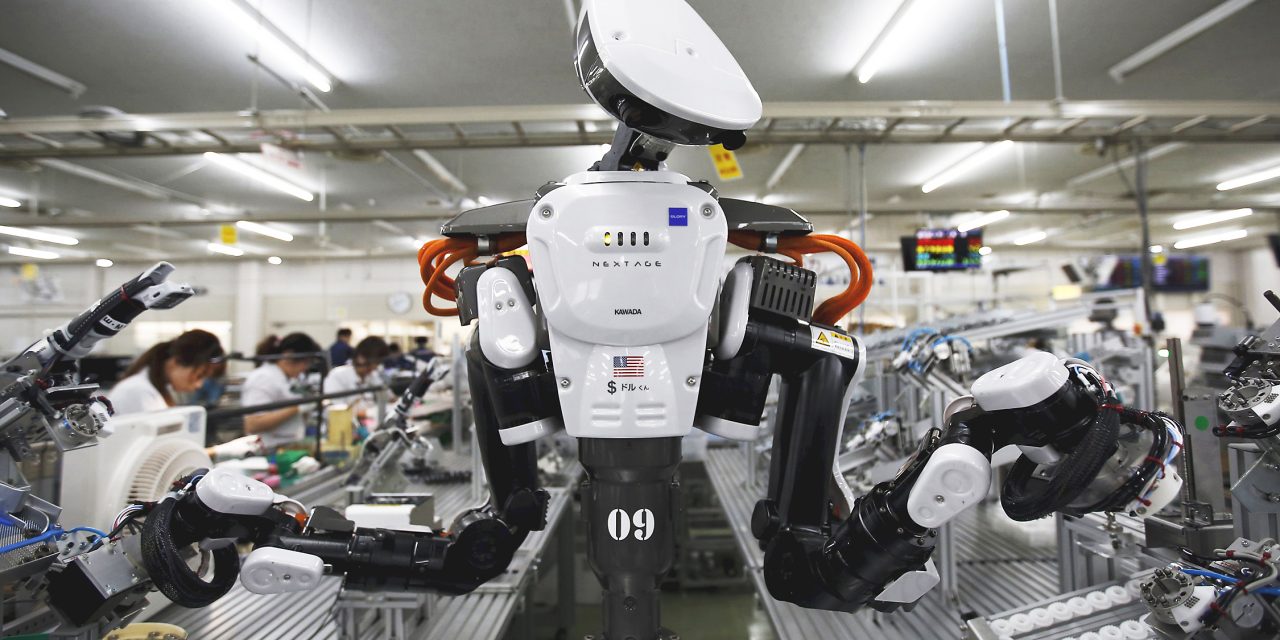
Michigan’s economy faces a tsunami of changes, more than most states, but businesses are not ready for what’s coming.
That is the conclusion reached by a new report that calculates the impact of automation, robotics and artificial intelligence (AI) on the state’s employers in the near future.
Economists have debated for years whether automation and AI would create a future workplace atmosphere that would eliminate millions of jobs. Among many experts, the conclusion is that robotics and other high-tech approaches toward business efficiency will actually create more jobs rather than replacing workers.
But those jobs, among blue-collar and many white-collar workers, will change dramatically. White-collar workers will likely be intimidated by AI robotics ability to reason, identify problems and analyze work flow.
In a piece published today by Crain’s Detroit Business, Tom Kelly, CEO of the southeast Michigan business group known as Automation Alley, assures that the mass unemployment predicted by some due to automation is a myth. He told Crain’s that robots take over a portion of the repetitive manufacturing process, but that frees up workers to engage in new tasks.
Kelly said that business owners view new technologies as something they need to keep an eye on, though they have made few changes to integrate with upcoming changes.
Here is what he told Crain’s:
The world going forward is so exciting if you’re a consumer. The things that you’ll be able to do, the life you’ll be able to lead, the quality of life that you will have — it’s going to be a wonderful time.
(But) if you are in a business and you don’t understand how technology is going to disrupt what you think you know about what your business model is — if you don’t understand AI, if you don’t understand 3D printing, if you don’t understand autonomous robotics — you are asking for a lot of trouble.
One year ago, as Gov. Gretchen Whitmer had just taken office, Tom Watkins urged the new governor to focus intently on efforts to make Michigan a savvy, AI-friendly state as revolutionary changes in the workplace “will present equal parts opportunity and threat to us all.”
A Michigan business consultant who has made countless trips to China, Watkins warned that the Chinese government is “surging ahead and it plans to dominate. AI is compatible with the communist government’s politics, policies and economic survival,” he wrote in a guest column for Michigan Advance.
With global economic disruptions sure to unfold, Watkins, the former Michigan schools superintendent, called on Whitmer to engage in a full-force effort by state government to get ready for the newest industrial revolution, with an advisory team consisting of “futurists, social scientists, economists, historians, sociologists, data scientists, law and management specialists, technologists, social planners and workforce specialists.”
Nonetheless, Kelly of Automation Alley presents a rosy picture with businesses fully engagied in a new world of work and production.
“The work is going to change, perhaps more profoundly for white-collar workers, but the work will become more valuable, which rises all boats,” he told Crain’s.
“So, companies make more money, employees make more money, there’s more need for employees — there’s more jobs that are going to be created because there’s more useful things we can do.”
Recent Posts:
 Work requirements for Food Stamps may sound like a…
- Michigan legislation takes aim at assault rifles
- Tonight’s Trump ‘Christmas Rally’ in Michigan…
- Ex-congressman from Michigan says fear of Trump…
- Michigan GOP turns to ‘My Pillow Guy” to lure Trump voters
- Top employer in Michigan – GM, Ford, Chrysler? No, U-M