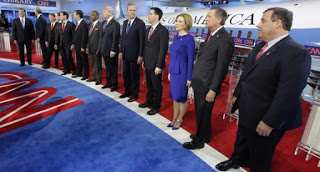
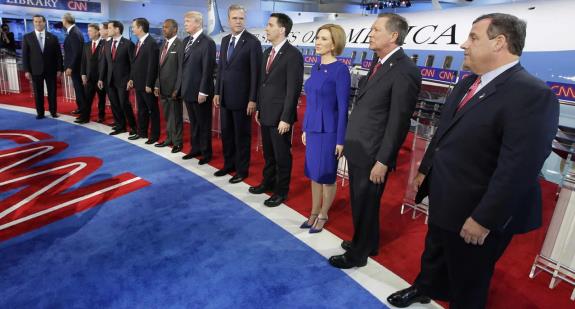
The huge field of Republican presidential candidates,
combined with the Michigan GOP’s complex method of awarding convention
delegates, could become messy as the votes come in on the night of March 8, the
state’s presidential primary.
Dividing up support among 15 candidates when the state has
only 59 GOP delegates will be contentious, perhaps equally so if only eight or 10
or 12 candidates are left when the race reaches March.
proportional basis – in each congressional district and statewide — is much
better-suited for a race with just a few contenders. With three delegates at
stake per district, the candidates in a two-person race would receive one
delegate for each one-third of the vote they capture.In that two-person race, the candidate who receives
two-thirds of the vote in a district would gain two delegates and the opponent
with one-third of the district’s electorate would receive one delegate.
But what about a race where the votes are divided in 10 or
15 ways?
For example, suppose the outcome in the 10th
District shows a winner by plurality with 20 percent, followed by second, third
and fourth place finishers at 14.5 percent, 13.9 percent and 13.4 percent. None
have reached the one-third threshold.
So, does that mean that the candidate who finished third
with far less than one-third support receives one delegate and the candidate
who finished just a few hundred votes behind receives no delegates? Maybe so.
and publisher Susan Demas and her predecessor, Bill Ballenger, engaged in a bit
of Q&A to dissect this process:
delegates) be selected?
14 congressional districts. Each district will be awarded three delegates to
the national convention. That’s 3×14=42. In addition, three delegates will be
taken up by the state party chair, the national committeewoman and the national
committeeman. That leaves 14 delegates to be apportioned based on the statewide
vote for the GOP presidential nominee on March 8.
take all? Can anybody get all 59 of Michigan’s delegates by winning more than
50% of the vote on March 8?
like Michigan, that has its primary before March 15 cannot be a ‘winner take
all’ state.
within congressional districts? Can there be ‘winner take all’ voting there?
Ted Cruz wins 67 percent (two thirds) of the vote in the 4th Congressional CD,
and Rand Paul gets 33 percent (one third) Cruz will get two delegates from that
district and Paul will get one. If there are more candidates on the ballot (and
there will be), who gets what will be based not only on how well they do in
that district, but how well they do statewide.
be?
most of what happens will be based on how the various candidates do statewide.
The allocation of delegates will be based on that. Only those candidates who
achieve at least 15 percent of the vote statewide will be guaranteed any
delegates at all. If a candidate meets the 15 percent threshold, s/he will be
guaranteed approximately 15 percent of the delegates, or as near to that as can
be determined by the party’s credentials committee.
delegates come from? What if a candidate has trouble getting 15 percent in any
individual CD but achieves the 15 percent statewide?
scour the district results statewide and determine where that particular
candidate should get his (or her) delegates, or use the 14-delegate ‘at large’
pool to reach the number that candidate deserves.
Recent Posts:
 Republicans could control Senate for many years to come
- Could Trump-induced mess in Washington lead to a new…
- Michigan Obamacare rate increases could average 28 percent
- Obamacare in a ‘death spiral?’ GOP and Berniecrats…
- Trump team favors Kid Rock over solid GOP field for Senate
- Liberal purists cheer GOP moderates, hate Dem moderates
- GOP Rep’s bill calls for elimination of state Senate