Whitmer
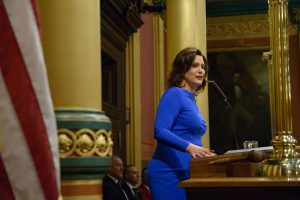
As Gov. Gretchen Whitmer is expected to emphasize roads issues in her State of the State address tonight, the latest news is that Macomb County ranks as the biggest donor county in the state for paying the most road taxes and fees that are sent elsewhere.
Nearly all of that donor money – consisting mostly of gas taxes and vehicle registration fees — is distributed to Michigan’s northern, rural counties, according to figures compiled by a state lawmaker.
Under the state’s road funding formula, Macomb, Wayne and Oakland counties lead the list of counties in the southern portion of Michigan who subsidize the roads in the sparsely populated areas in northern Michigan.
The 22 donor counties south of mid-Michigan are collectively sending over $138 million annually Up North for road repairs in the other 61 counties. Much of the disparity results from dramatic population differences and the prevalence of multi-lane roads in the south that are funded in an equal manner as the two-lane highways in the north.

Brixie
State Rep. Julie Brixie of the Lansing area (D-Meridian Township) analyzed all the state’s 83 counties on the basis of state road revenues per capita. Brixie found that all but one of the donor counties — Grand Traverse County — are south of Saginaw County. The MIRS news service in Lansing reported that those 22 counties are in the top 33 in population based on 2017 Census figures.
“People have been wondering why roads in certain parts of the state are way better than roads in other parts of the state, but nobody’s ever looked at (the raw numbers) . . . nobody’s ever quantified it with data,” Brixie told MIRS. “And this data that I got from MDOT (Michigan Department of Transportation) clearly shows that (the funding formula) is creating winners and losers.”
(MIRS is available only to subscribers but all the details of this report are available on Brixie’s Facebook page.)
If the distribution process was amended to distribute funds based on population, Macomb County would gain about $27.5 million a year in road money. In Wayne County, the gain would be $19.1 million. And in Oakland County the boost would amount to more than $16.7 million. Other populous counties such as Kent, Washtenaw, Ingham and Kalamazoo would also see multi-million dollar benefits.
But the obvious downside to this argument is that the gains sound plentiful, but they represent only a tiny slice of the pie for officials in large counties grappling with thousands of potholes and dozens of rickety bridges.

Hackel
For example, while MDOT and Whitmer say the state needs an increase of up to $2.5 billion in annual road revenues, Macomb County Executive Mark Hackel warned last year that his county needs $2.3 billion to fix all of its “poor condition” roads.
In other words, Lansing would need to give virtually all the added money from the first year of a road funding package to Macomb, and ignore the other 82 counties, in order to quickly fix the roads in the state’s third-largest county.
What’s worse, that $2.3 billion looming repair bill in Macomb refers just to the 1,773 miles of roads under the jurisdiction of the county Department of Roads. Macomb’s cities and villages have responsibility for another 2,300 miles of roads that add substantially to the county’s overall expense for transportation upkeep.
The state’s distribution system, created by Act 51 in 1951, does factor in population, but Brixie’s argument is that population only makes up a small component of the formula. And fairness demands changes.
The Act 51 funding formula delivers 39 percent of the state’s road revenues to MDOT-controlled roads, another 39 percent to county road departments/commissions, and 22 percent to cities and villages. That formula has faced criticism for decades in the state Capitol, with northern lawmakers battling southern lawmakers.
As for the counties that benefit most from the formula, Brixie found that the biggest subsidies go to Huron County, which receives an estimated $4.4 million of its total $9.4 million road budget from other counties, and Sanilac County, which gets $3.8 million of its $10.3 million from other counties.
And the revenue per capita figures show even greater disparities. Keweenaw County (population 2,105) led the list, averaging $939 road dollars per person from the state. Ontonagon County (population 5,881) averages $699 road dollars a person. The statewide average was $159 per person.