


In recent days, it’s become clear that Macomb County drain commissioner Tony Marrocco (above) and Oakland County drain commissioner Jim Nash both have ethical entanglements as they head into their final weeks of seeking re-election.
Neither official seems as pure as the waterways they are elected to protect – rivers and streams and lakes that are their combined, targeted destination when they have to dump sewer overflows.

Nash
Nash, a Democrat who pulled off a stunning election win four years ago, has compiled a campaign war chest this year of $125,000. But he hopes to put the final nail in the coffin of his Republican opponent on Oct. 27. On that day Nash will be the guest star of a fundraising party that’s charging $275 per plate.
The event, according to the invitation, is hosted by 10 engineering and construction firms that are reportedly paid contractors for the county and the drain commissioner – actually, in Oakland County, the position is called the water resources commissioner.
The group holding this soiree in Bloomfield Township, Pure Oakland Water, boasts on its website that it participates in numerous environmentally friendly events each year. Yet, the nonprofit organization’s board of directors includes just one true environmentalist. Most of the members consist of Nash’s underlings and people tied to the construction industry.
In a September Channel 7 report, Nash claimed that Oakland County’s partially treated sewage discharges have no detrimental impact on Lake St. Clair.
After billions of gallons of Oakland sewer water dumped into the Macomb County waterways and corresponding beach closings along Lake St. Clair for nearly a quarter century, many in Macomb would dispute Nash’s assertion.
But not necessarily Marrocco. The 24-year incumbent in Macomb County (who carries the official title of public works commissioner) has periodically defended Oakland County’s sewage discharges into the Red Run Drain, which flow into the Clinton River and then to the lake.
Marrocco, also a Democrat, has maintained a lucrative financial relationship with builders and contractors since he was first elected in 1992, with money pouring into his campaign committee and two political action committees (PACs). Since ‘92, he has never faced a strong re-election challenge until now – with Congresswoman Candice Miller retiring from Congress and taking on Marrocco in November.
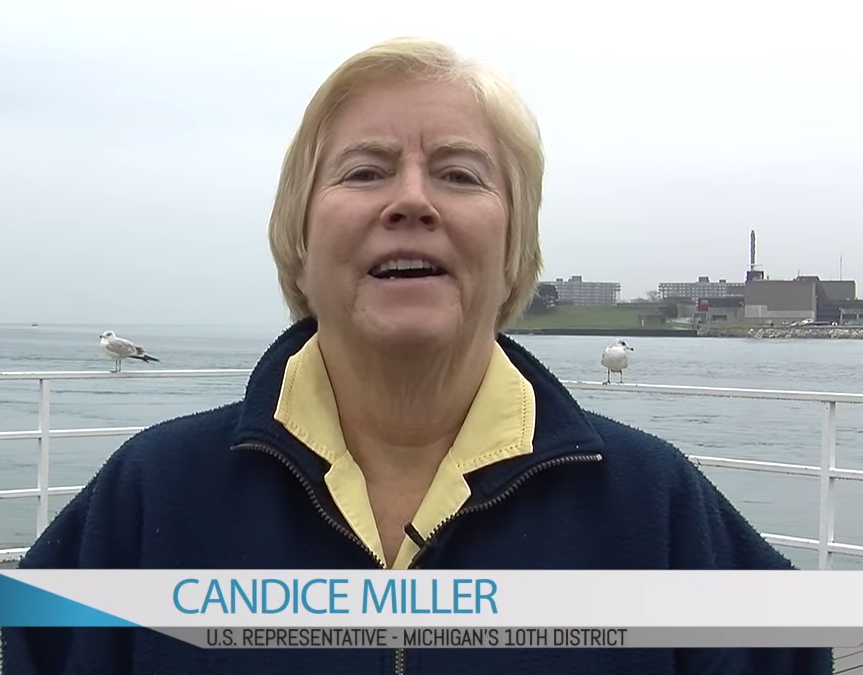
Miller
As a result, the incumbent has launched a series of expensive TV/Facebook ads, including one that was filmed at the Chapaton sewage retention facility in St. Clair Shores that he oversees.
On Wednesday, the Macomb County Ethics Board responded by ruling that Marrocco violated the county ethics ordinance when he used taxpayer-owned property for political gain. He was fined a measly $125 for his violation but the way he handled the situation probably says more than the board’s verdict.
The complaint filed by Leon Drolet of the Michigan Taxpayer’s Alliance declared that Marrocco had assembled several of his employees at Chapaton to take part on the day the commercial was filmed. This would be a blatant misuse of taxpayer resources. When a Channel 7 film crew arrived at the scene, Marrocco slipped out the front door of the sprawling facility.
Marrocco offered several defenses. He told the news media that he and employees involved in the commercials had taken a vacation day and were not on county time. He has said he obtained a rental permit (after the fact) to use the facility and paid a random $500 fee.
But he never officially responded to the complaint, filed several weeks ago, until he sent an email to ethics enforcement officials late on Tuesday evening. In that response he made the bizarre claim that his commercial filming activities were exempt from the county ethics ordinance because the Chapaton building did not belong to the county but was instead the property of an obscure drain board.
At this morning’s Ethics Board hearing, Marrocco was a no-show. He brushed aside the entire process. He sent no representatives or a staffer or an attorney.
Over the final three weeks of the election season, the incumbent will be lucky to survive, even as he engages in tangential campaign attacks on Miller regarding issues that have no connection to the job of public works commissioner. Miller, a 35-year political veteran, is well-funded and can match Marrocco, blow for blow.

Buxbaum
But in Oakland County, the GOP nominee, Robert Buxbaum, is the longest of long shots. He entered the final stretch of the campaign with an election committee that had $327 in the bank. Most people don’t donate to a newcomer, even if he has a PhD in chemical engineering from Princeton University, holds 12 patents and has worked as an engineering consultant for three decades.
Four years ago, Nash, a county commissioner at the time, went into the job green. But he has learned the ins and outs of collecting a lot of green to keep him in office.




As an environmental attorney (JD ’91 U of D) and chemical engineer (BS CHE ’81 from WSU) I have knowledge of the issues with CSO (combined sewer overflows) throughout Southeast Michigan. I am also very pro environment and am active in the land conservation as the past president of the Southeast Michigan Land Conservancy.
Your assertion that our current elected officials that oversee our sewer systems are somehow responsible for the sewer overflows is simply put erroneous and a disservice to their dedication and public service. Combined sewers (e.g. combining sanitary and storm effluents in the same pipe) are a HISTORICAL fact of life here in Southeast Michigan because combined sewers have been here for 100 years or so.. Combined sewers were initially installed when there were no sewer treatment plants and all effluent simply was discharged to lakes, streams and rivers. The federal government started requiring sewage treatment plants with the passage of to the Clean Water Act (CWA) in 1948 and amendments to it in the 1970s. However existing sewage treatment plants are not designed to handle wet weather flows — but only dry weather flows which contain the most pollutants. In 1977 it was estimated that it would cost us — as system customers — tens of BILLIONS of dollars to separate sanitary and storm sewers — costs that you and I would have to pay for through significantly higher taxes and water bills. More recently the CWA has enacted regulations for storm water effluent through the NPDES permit system which may have rendered separation of the effluents moot…
Over the past 30 years or so our historical combined sewers have begun to be retrofitted with storm water collection basins that are admittedly a compromise. These basins are designed to collect the high concentrations of pollutants in the effluents that are in the underground pipes at the time a rain even starts.. so those pollutants can be treated later. These basins collect for treatment 90 to 95 % of the pollutants for less than 10% of the cost of full separation. The rest of the sanitary effluent is diluted by the storm water to a significantly less concentrations that are much less harmful to the environment. And I say begun to be retrofitted because installation of storm water collection basins is not complete — the ongoing sewer improvements that have closed Middlebelt road in Farmington Hills between 12 and 13 mile road for the last year is a great example!
As such, I believe that Jim Nash’s statement about overflows to the rivers and lakes are taken out of context in that sensationalized Channel 7 news story of September 2016… His statement that the current overflows have no significant impact is probably true. Yes there is impact.. but it is substantially less than the historical impact from CSOs without storm water retention basins.