Sept. 28, 2015
A major study on U.S. immigration released today may play a role in the presidential campaign – and could be a blow to Donald Trump’s favorite topic.
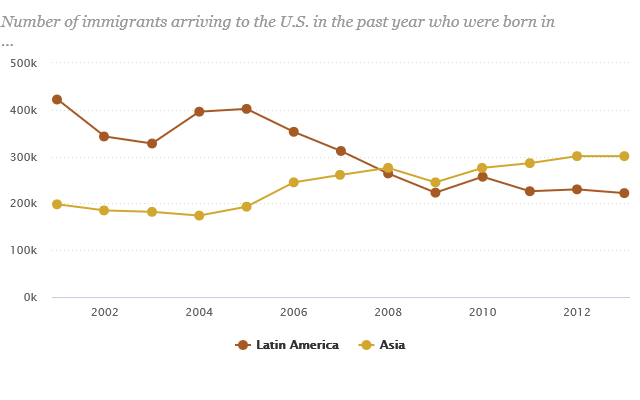
The Pew Research Center confirmed that in recent years immigration from Latin America has been slowing, mainly because of what the report calls an “abrupt slowdown” of illegal immigration from Mexico. Mexicans accounted for only 15 percent of all new immigrants arriving here in 2013, the Pew report found, and the share of newcomers who are Latino is at its lowest level in five decades.
In addition, the Mexican immigrants who are demonized by Trump rose rapidly during the 1990s but peaked in 2007. The number of unauthorized immigrants declined during the recession of 2008-10 before stabilizing. Since then, other reports have found, immigration from Mexico has produced a net-zero gain on an annual basis.
Pew estimates that, since 2009, there has been an average of about 350,000 new unauthorized immigrants each year. Of these, about 100,000 are Mexican, a much smaller share than in the past. In the years leading up to the Great Recession, Mexicans represented about half of new unauthorized immigrants. Cutting through all the xenophobic rhetoric, Pew informs us that 40 percent of recent immigrant arrivals — legal and illegal — are from Asia, Europe and Canada.
Contrary to the image of foreigners dashing across our borders on foot, the U.S. experiences a wide array of visitors annually and those who overstay their visas — issued for work, travel, university studies or visiting family members — represent a large portion of the nation’s undocumented immigrants.
The most striking change in the profile of the foreign-born population living in America is that Asia is the region of the globe that provides the largest source of recently arrived immigrants and has since 2011. China and India lead this surge. Here’s one more fact that crushes the Trump supporters’ stereotype of immigrants: 41 percent of the newly arrived in 2013 had at least a bachelor’s degree.
What is Trump fighting for?
If the border with Mexico has stabilized and the No. 1 source of immigration is now Asians who fly here utilizing – and sometimes abusing — our visa process, why is Trump focused on building a wall at the southern border?

The concentration is greater than that. As of 2013, one-fifth of all American immigrants lived in just five of the nation’s 3,000 counties: Los Angeles County, Calif.; Miami-Dade County, Fla.; Cook County, Ill.; Queens County, N.Y.; and Harris County, Texas. In most states, the undocumented, foreign-born population amounts
to 5 percent or less. In Michigan, it’s estimated at about 1 percent.
What’s more, Mexicans became the nation’s largest immigrant group in the 1980s but even after the wave of immigration from Mexico in the 1990s, ethnic groups other than Mexicans represent the largest bloc of immigrants in 17 states, according to Pew, including some of the nation’s largest states.
Chinese immigrants are the largest immigrant group in Massachusetts and Pennsylvania. Indians are the largest immigrant group in New
Jersey.
The big picture
“Between 1965 and 2015, new immigrants, their children and their grandchildren accounted for 55 percent of U.S. population growth. They added 72 million people to the nation’s population as it grew from 193 million in 1965 to 324 million in 2015. (That includes legal and illegal immigrants.)
“This fast-growing immigrant population also has driven the share of the U.S. population that is foreign born from 5 percent in 1965 to 14 percent today and will push it to a projected record 18 percent in 2065. Already, today’s 14 percent foreign-born share is a near historic record for the U.S., just slightly below the 15 percent levels seen shortly after the turn of the 20th century.