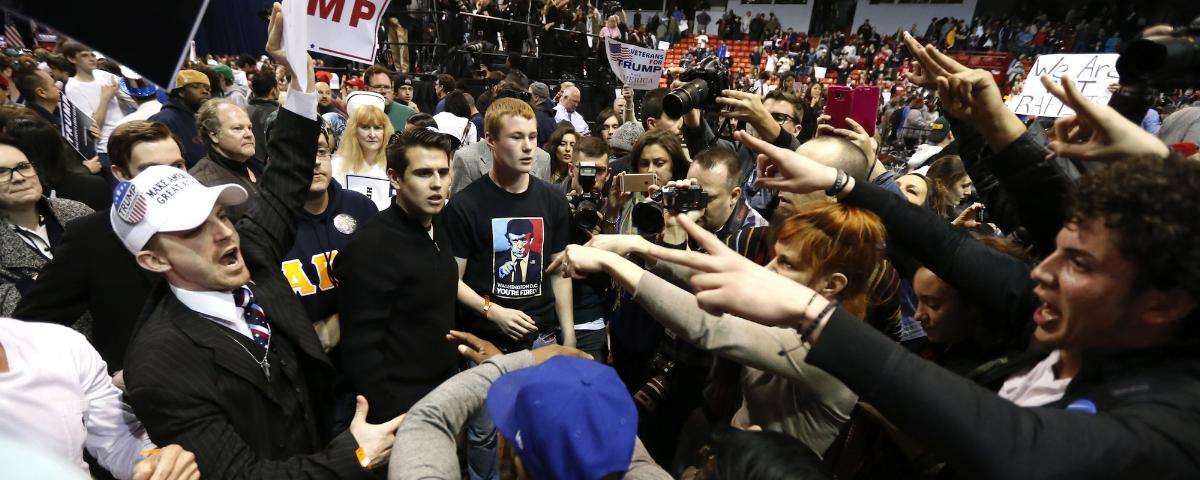
Last year an experiment was conducted to determine the lengths to which people now engage in partisan discrimination, the lashing out against persons based on their label – Democrat or Republican.
The results were disturbing.
In a paper published by the American Journal of Political Science, the authors asked a random sample of 1,021 adults to review the resumes of two fictitious high school students and determine which should receive a scholarship. The resumes offered equally qualified students, based on GPA and extracurricular activities, but one was president of the local Young Democrats and the other was the leader of the Young Republicans.
The adults chose the kid who shared their own political views 79 percent of the time. This partisan discrimination was even more prevalent than in a nearly identical experiment with racial differences among the two scholarship candidates.
Contempt for the other side of the political fight is so strong that adults are willing to punish kids in a very significant way for their political views.
David Broockman is not a high school student but in 2014, as a political science graduate student at UC Berkeley, he conducted a study of voters that may have subtly predicted the rise of Sanders and Trump voters in 2016.
Beyond strident partisanship, Broockman found that “disengaged and infrequent voters” were driving the politicians’ willingness to tap into the anger and hyper-partisanship among the electorate. The disengaged voters, often incorrectly associated with the moderate middle, were fueling the drift by politicians toward extremist views. Politically active voters are not the driving force, and the extremism in both parties relates to specific issues more so than a sudden, overall lurch to the right or left, Broockman concluded.
“Indeed, although each of the parties is out of step with public sentiment on some issues, neither consistently outflanks the public. For example, about 40 percent of Americans seem to have more liberal positions on tax policies than most Democratic elected officials, while much of the public would also prefer more conservative policies on immigration and abortion than most Republican elected officials would endorse,” he wrote in an Op-Ed column for The Washington Post.
The Pew Research Center and numerous scholars have found that the increasing trend of liberals living in liberal neighborhoods and conservatives in conservative communities has reached a tipping point. Many of the diehards on the left and right openly admit that they don’t want to associate with the other side.
 This partisan segregation came through in a 2014 survey which found that 50 percent of self-identified “consistently conservative” people and 35 percent of the “consistently liberal” do not want to live among those who don’t share their political views.
A touchier subject going back to the days of veiled bigotry – whether a parent would be unhappy with one of their children marrying someone of a different race – has now come to the forefront in a blatantly political manner.
Pew found that three out of ten consistent conservatives said they would be unhappy if an immediate family member married a Democrat, and about a quarter (23%) of purist liberals said the same about the prospect of a Republican in-law.
In a recent column for the New York Times, Arthur C. Brooks, president of the staunchly conservative American Enterprise Institute, pleaded with partisans to set aside their contempt and, on an individual basis, try to heal the ideological divide in America.
Brooks offered this warning:
There is a Polarization Industrial Complex in American media today, which profits handsomely from the continuing climate of bitterness. Not surprisingly, polarization in the House and Senate is at its highest since the end of Reconstruction in the 1870s.
Bigotry’s cousin is contempt. In the words of the 19th-century philosopher Arthur Schopenhauer, contempt is “the unsullied conviction of the worthlessness of another.” Watch and listen to politically polarized commentary today, and you will see that it is more contemptuous than angry, overflowing with sneering, mockery and disgust.
Brooks views the road toward moderation and tolerance as a spiritual journey for the nation. He even cites some of the wisdom imparted on him by the Dalai Lama. He implored:
Each of us can be one part of the solution America needs to become a more pluralistic, tolerant country, in which differences are part of a competition of ideas, and not a ghastly holy war of ideologies.
We shall see if the final outcome of the rough-and-tumble 2016 campaign is an electorate willing to call a truce. God knows, we all have enough holy wars already in our world.
Photos/CNN