
Perhaps it’s time to wave goodbye to the American political
circus of summer 2015 and get serious about what lies ahead. And what stares our
potential leaders in the face.
At a time when net migration at the Mexican border has
remained flat for several years, should illegal immigration to the United
States play a leading role in our presidential campaign?
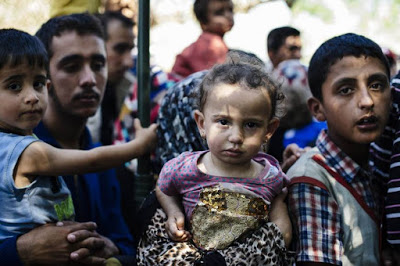
At a moment when Middle Easterners flee the barbarism of
ISIS and other chaos in the war-torn region, too often dying at sea along the
way, and our European allies struggle feebly to deal with their overwhelming
influx of desperate souls, shouldn’t that calamity become a focus for the leading
country on earth?
people, we endured 11 million undocumented immigrants over a few decades. But
Europe deals with about 800,000 migratory arrivals over just a few months. In
some cases, nations that are tiny compared to the United States and suffer from
tattered economies take in thousands of refugees each week.
Pope Francis, international charitable organizations and
the United Nations have all called for global assistance as this mass migration
reaches beyond a European crisis.
the geographic area of Michigan and which barely avoided a financial collapse
earlier this year, accepted nearly 100,000 refugees already this year. If
Michigan, on a proportionate basis, endured such an intake that would mean
close to 200,000 people with no means of support arriving here within eight
months – more than the population of Lansing and Kalamazoo combined.
Of course, the U.S. rightfully should offer a
disproportionate share of the help. After all, a majority of those seeking
refuge come from Syria, Iraq, Afghanistan and Libya, nations where U.S.
military intervention and failed foreign policy certainly played a key role in
this exodus from the Middle East and surrounding territories.
America, as a nation of immigrants, enjoys a proud
history as the world leader in refugee resettlement. We have always viewed such
compassion for the downtrodden fleeing violence as a moral responsibility in
our role as the richest nation across the globe.
But as the European Union badly fumbles through this catastrophe,
U.S. leaders have barely paid heed to the human devastation. The gaggle of
presidential wannabes on the campaign trail should be reminded that big issues
like these on the world stage are the greatest challenge faced within the
pressure cooker of the Oval Office, not small matters such as the issuance of
marriage licenses in a small Kentucky county.
of reality, social media jolts us with visuals that the facts and figures of
traditional media reporting cannot offer. Such was the case when a heart-in-your-throat
moment occurred last week as photos of the body of Aylan Kurdi, a 3-year-old refugee
who washed ashore, went viral. The Syrian
boy’s mother and brother also drowned when their boat capsized while trying to
cross the Aegean Sea from the shores of Turkey.
Here is a CNN report on the discovery of the boy’s body:

asking why it took so long for America to take more than a passing notice of this
widespread atrocity:
“The death of any child is devastating. But these
children’s stories are particularly painful to read about, because they carry a
reproach for readers like us: We let this happen. We left those innocent
children to this fate. We knew refugee children were in danger, and did
nothing, and this is the result.
“And make no mistake: We did know. As the refugee boats
have crossed the Mediterranean, photograph
after photograph has showed rescue workers cradling tiny babies and
toddlers rescued from the water. We knew desperate families were bringing
children on these journeys. We knew they would keep coming, because what could
drive a parent to bring a child on such a dangerous crossing except fear that
staying behind would be worse? And we knew that if we didn’t do more to help
them, many
of those children would die — and so would their families.
hold our attention. An infant saved from a boat wasn’t good enough for us: We needed
to see one dead on a beach, lying alone, face down, in the surf.”
The Syrian civil war, often fought in a crude and
especially deadly manner for four years, displaced 4 million people. But in
that time the U.S. resettled just 1,434
Syrian refugees.
According to international organizations, more refugees wander
across Europe today than at any other time since World War II. The record numbers
of people fleeing violence across the Middle East and across North Africa, attempt
to cross the Mediterranean and Aegean seas in rickety boats and rubber dinghies.
So far this year, 2,500 have perished taking that perilous route.
Those who choose a circuitous path over land,
surrendering their fate to human smugglers, also sometimes die along the way.
That reality was brought home recently when an abandoned truck with 70 dead
refugees inside the rear compartment, including a 2-year-old child, was found
at the side of an Austrian roadway.
Greece, Italy, Bulgaria, Macedonia, Hungary, Austria, Germany, Sweden, France and the United
Kingdom.
Here’s how Taub describes the relief effort:
Kuwait respectively pledged $1.2 billion, $507 million, and $500 million for
aid to refugees. That’s good, but it’s still far
short of the $5.5 billion in aid that the UN says is needed for these
refugees, as well as another $2.9 billion for displaced Syrians within Syria.
“As a result, the (refugee) camps are often crowded and
undersupplied, which leaves the people who live in them cold, hungry, and
subject to the ravages of disease.”
Catholics to help house refugees. He said the Vatican’s parishes will be taking
in two families (not impressive). The pope said it was simply not enough to say
“have courage, hang in there,” to those people seeking better
lives.
You can fully expect the pontiff to call on Americans to
lend a hand when he visits the U.S. later this month.
Leaders in some parts of Europe, whose homelands
benefited from the gracious embrace of their fleeing refugees by neighboring
nations during the brutal invasions by Nazi Germany and the Soviet Union, now have
stood for months in shameless solidarity, trying to block their borders from
this 2015 wave of helpless families seeking asylum from the madness of the
post-Arab Spring.
Yet, some breakthroughs have come in recent days. The UK,
after engaging in some ugly, xenophobic politics over several months, announced
it will let in thousands of refugees fleeing the Syrian civil war, which has
killed 250,000 people.
at least on a temporary basis. In Hungary, the government finally relented in
its inhumane treatment of those migrating northward through Europe. After
refugees and migrants were forcibly removed from trains and placed in squalid
refugee camps, on Friday the displaced defiantly began a 300-mile walk from
Hungary to Germany. In response, Hungary agreed to bus them and thousands more
migrants to the Austrian border.
Kudos to Icelanders, who on
Facebook have been volunteering to pay for the flights of Syrian refugees
and then care for them in their homes. Thousands of Icelanders have backed this
effort – reportedly one in every 32 residents of the remote island nation —
under the slogan “Just because it isn’t happening here doesn’t mean it isn’t
happening.”
of all this ugliness, the lack of responsiveness inspired Michael Ignatieff, a Harvard
professor and a Canadian native, to call on key Western nations to step up:
“The United States and its allies are at war with the
Islamic State in Syria — fine, everyone agrees they are a threat — but don’t
we have some responsibility toward the refugees fleeing the combat? If we’ve
been arming Syrian rebels, shouldn’t we also be helping the people trying to
get out of their way? If we’ve failed to broker peace in Syria, can’t we help
the people who can’t wait for peace any longer?
“It’s not just the United States that keeps pretending
the refugee catastrophe is a European problem. Look at countries that pride
themselves on being havens for the homeless. Canada, where I come from? As few
as 1,074 Syrians (over four years), as of August. Australia? No more than
2,200. Brazil? Fewer than 2,000, as of May.”
As for U.S. Secretary of State John Kerry, he said in
recent days that the U.S. should help build additional refugee camps to relieve
the overflowing facilities in Jordan, Lebanon and Turkey. Clearly, that’s not
enough.
We have some catching up to do. The United States’ long
history as a beacon in welcoming refugees from deadly parts of the planet remains
tattered over the past decade as our willingness to take in Iraqis fleeing the
war we created was less than stellar.
Still, another treasured chapter in our history centers
on the United States’ ability to forge a dramatic impact on the face of Europe
for 60 years.
problem. They are not teeming to our shores as huddled masses yearning to
breathe free. But we can certainly embrace them as our own.
Are these refugees quite literally our responsibility?
No.
But, as Pope Francis would ask, are they God’s children,
a desperate slice of humanity that deserves our compassion?
Yes. Absolutely,
yes.
Aylan Kurdi, we certainly have the resources to do so. We can offer a new version
of our grand history on the European continent. We certainly have the ability
to swoop in and save the day.