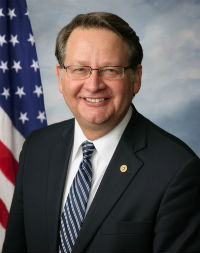
Sen. Gary Peters, a quiet holdout in the fierce debate
over the Iran nuclear deal, announced today that he will support the agreement.
The Michigan Democrat said that he reached his decision
after traveling to five Middle Eastern nations and talking with officials there,
as well as U.S. military personnel.
In a 2,200-word statement, Peters explained in detail why
he will “reluctantly” vote against a Senate measure designed to reject the
deal. Here’s portion of what the freshman senator said:
“Although the agreement contains positive aspects, I
remain extremely concerned that after fifteen years, the restrictions on how
much uranium Iran can enrich and to what level expire and Iran will once again
return to its current status as a nuclear threshold state with a breakout time
of just a couple of months, if not weeks. It is disconcerting that Iran can
achieve this status without breaking the rules or bending the agreement. To be
clear, in fifteen years, Iran will be allowed to be a legitimized threshold
nuclear state.
“Fifteen years may seem like a very long time, but
fifteen years from now, a different president and a different Congress may once
again face the threat of an Iran with nuclear weapons capability and access to
industrial-style enrichment. That future Iran will likely be wealthier and less
isolated than the Iran of today, and may pose a more significant threat to the
U.S. and world security.
“So the question remains, what will the government of the
United States do to ensure that the terms of the JCPOA (Joint Comprehensive
Plan of Action ) do not become the new normal? How can we ensure that
inspections and verification responsibility remains with independent
investigators such as the experts at the IAEA? What will we do to ensure that
Iran does not have domestic enrichment capabilities that we will not even
entrust to our allies? These have been the central questions vexing me during
my deliberations on JCPOA. In the next fifteen years, the world community must
continue to act in unison and move towards a stronger non-proliferation policy
than was embodied in this agreement. My fear is that fifteen years from now,
America and the world will face an Iran that sees its enrichment power as
legitimized, that is wealthier and more economically powerful, and an Iran that
is fortified with new weapons and air defenses as embargoes on conventional
arms and ballistic missiles expire five and eight years from now.
“While zero uranium enrichment would be the preferred
outcome of this agreement, I concede it is not realistic to expect that Iran
would agree to forgo all enrichment. The JCPOA would be much stronger if it
included protocols that permanently limit Iran’s enrichment levels. And if Iran
insisted on enrichment of uranium, America and our negotiating partners should
have insisted on ensuring that those levels remain below the level necessary
for weaponization in perpetuity.
“Despite my serious concerns with this agreement, I have
unfortunately become convinced that we are faced with no viable alternative. I
have met with representatives for each of our negotiating partners, whom have
all stated that they will not return to the negotiating table if Congress
rejects this deal. Further, I believe a rejection of this agreement will damage
the international credibility of the United States, and that attempting to go
it alone and implement unilateral sanctions without a coalition of nations will
only weaken our standing.”
You can read the full statement here.