Some congressional Republicans who represent marginal districts may be a bit nervous about how the Paul Ryan budget, approved on Thursday, could be used against them at election time.
But not Rep. Candy Miller.
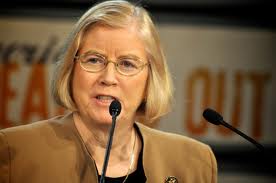
A Harrison Township Republican, Miller has the distinct advantage of having no credible Democratic challenger on the horizon as the May filing deadline approaches.
Nonethless, she is a forceful advocate for the Ryan approach.
In a statement after the House passed the plan, Miller said:
“House Republicans have passed a budget that I believe is a true path to prosperity that will not only put our budget on a path to balance, but pay off our national debt over time.
“This budget offers specific proposals that will strengthen and protect the health and retirement security of seniors and the economic security of every American. It also outlines common sense tax reforms that simplifies the tax code, lowers rates and closes special interest loop holes that will bring about economic expansion.”
This is clearly a starve-the-beast approach that goes far beyond anything Newt Gingrich or Ronald Reagan proposed in their bid to shrink the federal government.
The nonpartisan Concord Coalition says Congressman Ryan’s budget shows how impossible it is to realistically cut the budget without raising taxes.
The Center for Budget and Policy Priorities, another nonpartisan think tank, concluded that tax cuts in the Ryan budget would give millionaires another $265,000 on top of the existing Bush tax cuts.
The CBPP also calculated that Ryan gets 62 percent of his big budget cuts from low-income programs, such as food stamps, Pell grants for college tuition, and job training.
Overall, discretionary spending would fall to $406 billion, a reduction of $100 billion, or nearly 20 percent.
In other words, there’s plenty of ammunition in that budget plan that could blow up the Republicans’ plan to overtake the Senate. It could also shrink the GOP majority in the House.
 |
| (Sun-Sentinel.com photo) |
Democratic Rep. Sandy Levin, who represents most of Macomb County, is sticking with the liberal mantra that the Ryan budget helps the rich at the expense of the poor:
“The only way to cut the top tax rate to 25 percent is to essentially end the tax deductions for health care coverage, mortgage interest expenses and charitable contributions, even as Republicans would keep the temporary lower rates for capital gains and dividends that mainly benefit very high-income taxpayers.
“Under the guise of deficit reduction, Republicans are again attempting to end the Medicare guarantee and shift costs to seniors and people with disabilities.”
But there’s another problem with the Ryan budget that hasn’t received much attention yet – an unrealistic timetable and rosy scenarios regarding the overall budget savings.
According to Politico, when lawmakers return in mid-April from their spring recess, the Republican budget resolution gives six House committees an April 27 deadline to come up with an additional $261 billion in 10-year savings. That is required to forestall a January “sequester” from the Defense Department, which was mandated after the failure of the congressional supercommittee.
No one on Capitol Hill believes those committees can move that fast.
The Armed Services Committee is exempt, breaking faith with the spirit of the August debt-ceiling accords, Politico reports. Instead, food stamps, health care programs and federal worker retirement benefits are the prime targets.
In the case of Medicaid, the GOP promises a gradual approach, siphoning savings already proposed by the White House. But the budget unrealistically assumes $50 billion in long-term savings attributed to contentious medical liability reforms.
As for food stamps, the current benefit levels, put in place at the height of nation’s financial crisis, already are slated to be phased out entirely by November 2013. But the Ryan budget engages in a bit of gimmickry by projecting $7 billion in savings by moving up the end of the enhanced benefits to July 1.