

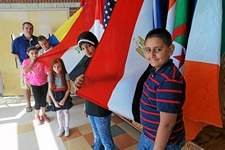
This is a significant story that got lost in all the news-clutter of last week. The old image of Macomb County consisting of three colors — lily white, blue collar and redneck — is long gone. The flags of all the nations represented by the county’s foreign born population (nearly 50 percent in some areas) represent nearly every color of the international rainbow.
It’s a long piece but it’s certainly worth a “Save” or a bookmark so that you can read it at your leisure.
By Chad Selweski
chad.selweski@macombdaily.com; @cbsnewsman
Tuesday, August 20,2013

Holden Elementary School
in Sterling Heights displays in its lobby dozens of flags that
represent all the countries of its diverse student body. From left to
right are teacher Bill Piscopink; Adnan Kepes holds the flag of Bosnia;
Merna Naeem and Rita Arfro are from Iraq; and Laila Muthanna and
Kirollos Ibrahim are from Egypt. The Macomb Daily/DAVID DALTON
For decades, gritty, blue-collar Macomb County featured a
substantial ethnic population but it has now become a melting pot where
families from dozens of countries, many of them led by white-collar
breadwinners, have settled in.
Almost 100 languages are now spoken
across the county and in some residential areas the concentration of
immigrants approaches 50 percent of the population.
Cities and
townships that were once dominated by three ethnic groups — Germans,
Italians and Poles — are now home to families who emigrated from Iraq,
India, Albania, Bangladesh, Lebanon, Mexico, the Philippines, Serbia,
Croatia, Ukraine, Laos and Thailand.
“There’s this tremendous
diversity, a rich diversity, in the immigrant groups of Macomb County
and much of the entire region. We don’t have just Latinos or one group
that dominates,” said Kurt Metzger, director of the Data Driven Detroit
research firm.
According to a new report produced by DDD and
another group that studies Detroit area demographics, Global Detroit,
much of Macomb’s foreign-born population has established residency along
the Mound/Dequindre corridor in Warren and Sterling Heights. These
ethnic clusters also spill over into Shelby Township, Troy and Madison
Heights.
Macomb’s melting pot, its ethnic stew, features the
largest Albanian population of any county in America. Yet the Albanians
and other prominent ethnic groups are largely “invisible” because they
are dispersed, according to the Global Detroit/DDD study.
Macomb County has no Chinatown or Mexicantown.
Susan
Katulla of Sterling Heights, a Chaldean who came to the United States
as an infant, said that the Mound/Dequindre corridor became a settlement
location for immigrants and refugees almost by chance. The early
Chaldeans — about 400 families in 1987 — were attracted by the jobs and low cost of living in Macomb County.
Many
more followed, including refugees fleeing the Gulf War and Iraq War.
The most recent estimates indicate 70,000 Chaldeans and other Iraqi
Christians live in Macomb County, with 25,000 to 30,000 located in
Sterling Heights alone.
“There are businesses in that area that
cater to ethnic communities, selling favorite foods, vegetables,
spices,” said Katulla, vice chair of the Sterling Heights Ethnic
Community Committee. “The people like to have family close to them. They
want a place to shop that’s close to them. They want a church that’s
close to them.”
Churches are ‘magnets’
For most of the immigrant enclaves, the church is the anchor of the community, the main draw for those seeking a place to live.
The
Macedonian and Serbian communities built towering, ornate churches in
Sterling Heights. The Sikh community last year constructed a temple, a
gurdwara, nearby. The Assyrians, another sect of Iraqi Christians,
established a church on Ryan Road in Warren.
Filipinos were attracted to
that same corridor by the number of Catholic churches, including some
with priests that are first-generation immigrants from the Philippines,
according to Betsy Henry, president of the Filipino Chamber of Commerce,
located in Rochester Hills.
Another big draw is a Filipino
cultural and activities center in Southfield and the huge annual picnic
at Warren’s Halmich Park in June to celebrate Kalyaan, Independence Day
for the Philippines. The event attracts 3,000 to 5,000 Filipinos of all
generations.
“Filipinos are very fun-loving, gregarious people. They love to dance and sing,” Henry said.
Many
of the recent arrivals to the United States entered on work visas. They
are college-educated immigrants who were sponsored under a 3- to 5-year
agreement with an employer. A large number have gone into the health
care field as nurses or physical therapists.
Steve Tobocman,
director of Global Detroit, said that robust immigration strengthens the
local economy and creates more jobs, as highly skilled professionals
and entrepreneurs make the Detroit area home. The immigration reforms
pending in Congress would add to that momentum, he believes.
“People
may tend to think of Macomb County as not as diverse as Wayne County or
Oakland County, but some of the most concentrated populations of
foreign-born immigrants are in Macomb,” said Tobocman, a former state
House member who represented southwest Detroit.
Exploding the myths
The Global Detroit/DDD report depicts a flattering picture of the Detroit-area immigrant populace:
*
40 percent of the immigrant population has a bachelor’s or
graduate-level college degree, significantly above the educational
attainment of local residents who were born in the U.S.
* Two-thirds of foreign-born immigrants own their homes, and 52 percent have become naturalized citizens.
* The average income for this first-generation immigrant group is $61,000 for males and $41,000 for females.
*
Foreign-born residents have a higher rate of employment — 90 percent
vs. 84 percent for American-born workers — and only 7 percent work in
the public sector.
* Immigrants have a much higher percentage of
workers in four categories — management, business, science and the arts —
than naturalized citizens.
* The foreign-born are much more likely to be married than American-born residents, and half as likely to be divorced.
In
Macomb County, six sections — U.S. Census tracts — within the Sterling
Heights Mound/Dequindre corridor feature foreign-born populations of 35
percent to 42 percent.
In the surrounding neighborhoods of
Sterling Heights, Warren and Shelby Township, several census tracts are
highlighted by foreign-born populations above 20 percent.
The
assimilation of these newcomers from a vast array of nations falls on
the school districts, nonprofit groups associated with particular
ethnicities, and organizations such as Global Detroit. Assistance with
finding housing, a job and dealing with “culture shock” are offered by
numerous groups.
The Mount Clemens-based Interfaith Center for
Racial Justice in 2007 launched a rotating, 5-week program of workshops
called “Listen, Learn and Live” that teach residents about other
cultures and religions. That effort, according to ICRJ Director the Rev.
Michail Curro, expanded into week-long summer day camps run by two
churches in south Warren for a diverse group of immigrant kids.
At
the public schools, the biggest challenge is integrating kids into the
American system of education and getting them into an English as a
Second Language class.
92 languages
Immigrants in Macomb County
schools speak at least 92 languages at home, according to Judy
Pritchett, chief academic officer for the Macomb Intermediate School
District. That is considered a low estimate Of the approximately 10,000 K-12 students attending sessions
known as English Language Learners classes, the vast majority are
enrolled in the Warren Consolidated and Utica school districts.
Katulla,
the lone Chaldean member of the Warren Consolidated school board, said
her district provides interpreters via a two-way phone system to help
immigrant parents communicate with teachers.
But the chasm some kids face in becoming functional in American society goes beyond language skills.
“Many
of these kids have gaps in their education due to the trauma of war or
persecution or family separations,” Katulla said. “We can have an
eighth-grader who last went to school in the second grade.”
Parents
also receive assistance with English language classes but Katulla said
that at the Chaldean Community Foundation, where she works, sad stories
abound. She offered the example of an immigrant pharmacist who was
working a menial, 12-hours-a-day job and has no time to attend
English-learning sessions so he can secure a job in his field.
“Many of these people have so much talent, but they speak no English,” she said.
While Macomb County may not have a Chaldeantown or an Indiantown, it once came close to establishing a Ukrainiantown.
In
the 1960s, at a time when just a few big ethnic contingents were
concentrated within the county populace, immigrants from Ukraine began
migrating north from Hamtramck and surrounding Detroit neighborhoods to
Warren, specifically the area at 11 Mile and Ryan.
The
construction of St. Josaphat Ukrainian Catholic Church was the “magnet”
that sparked the exodus, according to Ukrainian community leaders. What
followed was a Ukrainian housing complex, two Ukrainian credit unions
where the tellers spoke the native language, and the Ukrainian Cultural
Center, which features a large banquet room and has hosted former
presidents George H.W. Bush and Bill Clinton.
About a mile away,
near 12 Mile and Dequindre, the remnants of the Ukrainians who had
worshipped at Immaculate Conception Catholic Church in Hamtramck
established a K-12 Immaculate Conception school within a shuttered
public school building. The high school eventually closed but the
elementary school lives on. Over time, several Ukrainian sports clubs
for kids have also been formed.
Andrey Duzyj, former president of
the Ukrainian Cultural Center, said many of the older Macomb County
Ukrainians have died off or moved on. But the downfall of the Soviet
Union in 1991 sparked a second exodus of immigrants from Ukraine, the
former “Captive Nation,” to America in search of economic opportunity.
“They call themselves the ‘new wave’ — and that’s fine,” Duzyj said. “We just want to keep our heritage alive.”


A fantastic blog with a lot of useful information. I would love to get updates from you. Keep blogging. All the best.