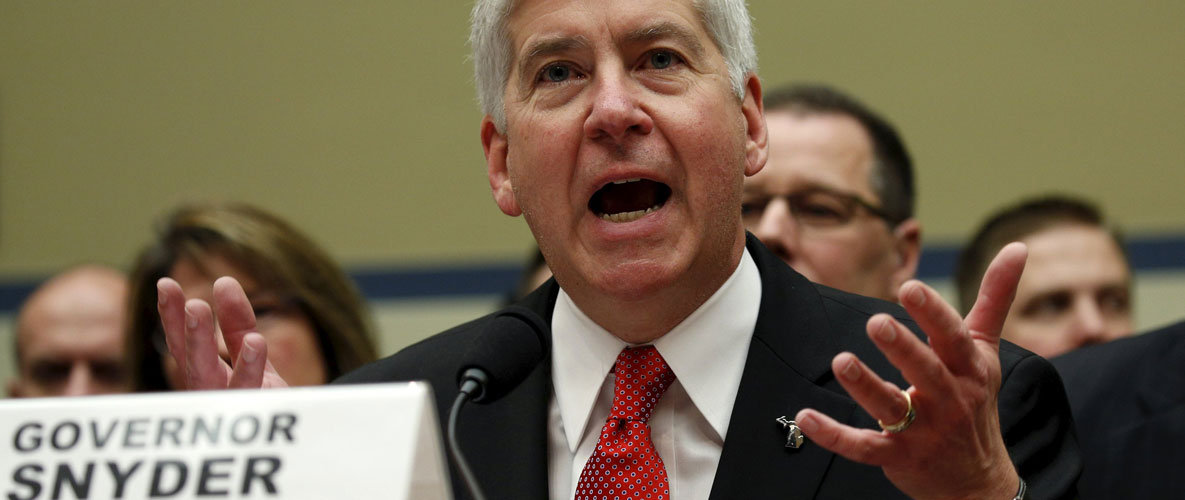
Gov. Rick Snyder’s increasingly murky legacy due to the Flint water crisis will be preserved for many years in an apolitical atmosphere – the university classroom.
In fact, business administration experts in academia already teach comparisons of the Snyder administration’s gross mismanagement of the Flint debacle to the devastating BP oil spill in the Gulf of Mexico.
Kudos to Ron French of Bridge Magazine for uncovering a fresh angle to the Flint story, one that ventures into new waters. French talked with several leading professors and deans from Michigan business schools and found that the black eye suffered by Snyder due to Flint may be on display in classrooms for decades to come.
How bad is it? In addition to the Deepwater Horizon spill, Bridge Magazine heard comparisons to the inept crisis management displayed with regard to Hurricane Katrina, the space shuttle Challenger explosion, the Catholic Church’s response to priests molesting children – even the Belgian police forces’ reaction to terror threats.
Beyond the classroom, the “group think” and denial on display within the administration will be the subject of academic research that leads to papers and presentations. Lessons will be learned.
Here’s a small piece of French’s report:
(Lynn) Wooten (a U-M associate dean) said Snyder and other state officials should have been more open to the data of outside researchers, such as Dr. Mona Hanna-Atisha who found increased rates of lead poisoning in Flint children, and Virginia Tech’s Marc Edwards, who found dangerous levels of lead in the drinking water. CEOs need to listen to experts with different points of view. “You need insiders and outsiders on a good team,” Wooten said. “They may drive you crazy in meetings, but you need people who are willing to tell you the truth.”
“There’s a phenomenon called escalation of commitment to a bad decision,” said (Nancy) Levenburg, the Grand Valley management professor. “A group rationalizes its decisions (despite) increasingly negative outcomes. Under this phenomenon, once you start to see things go bad, you dig in.”
Wayne State’s Matthew Seeger said the state’s mismanagement of Flint reveals the need to “build organization systems that are very sensitive to risks when (risks) come up. We need ombudspersons and anonymous tip lines so leaders can get these kinds of concerns.”